How Online Math Tutoring Prepares Kids for Competitive Exams

- Competitive exams test strategic thinking under pressure, not just math knowledge.
- An 8-week structured plan with diagnostics, timed practice, and full simulations drives score gains.
- Online tutoring matches in-person effectiveness, especially when it mirrors real test environments.
- Mental math shortcuts and the POWER method can save 10–25 seconds per question.
- Red-flag tutors skip diagnostics, timed practice, and exam-specific track records.
Imagine your teen opening the Bluebook™ app, seeing the built-in Desmos® calculator pop up, and thinking: I’ve practiced this exact setup with my tutor. I know what to do. That’s the quiet edge great online math tutoring provides — familiarity with the test experience, targeted practice on the right skills, and a plan that fits around real life. And yes, the research backs it: tutoring — including fully online tutoring — drives meaningful gains in math. Students preparing for IB Math can work with an IB Math HL/SL tutor who understands exactly what these high-stakes exams demand.
What Counts as Competitive Exams (USA/Canada)?
- SAT (Digital) — Taken in Bluebook with an embedded Desmos graphing calculator and official full-length practice tests.
- ACT Math — Algebra, functions, geometry, statistics & probability, with clear official blueprints and weightings.
- AP Calculus AB / AP Statistics — College-level pacing and free-response; current formats and past FRQs are public.
- AMC 10/12 (MAA) — 25 questions in 75 minutes; problem-solving across algebra, geometry, counting/probability, number theory.
- CEMC (University of Waterloo) — Canadian contests with extensive past papers and solutions.
Why Good at School Math Isn’t Always Ready for the Exam
Here’s what most parents don’t realize: competitive exams don’t just test math — they test strategic thinking under pressure.
Sarah, a parent from Toronto I worked with, put it perfectly: “My daughter knew all the math concepts, but she’d panic during timed tests and make careless mistakes. Her school grades were excellent, but her practice SAT scores were disappointing.”
Where Traditional Teaching Falls Short for Exam Day
- Lightning-fast pattern recognition
- Elimination techniques to cut through traps
- Time management under pressure
- Mental math & estimation to save minutes
- Confidence with unfamiliar formats
This is where specialized online math tutoring changes the game — because it can rehearse the exact conditions students will face. To understand why a regular math tutor might not be enough, look at the fundamental difference in approach required for these exams.
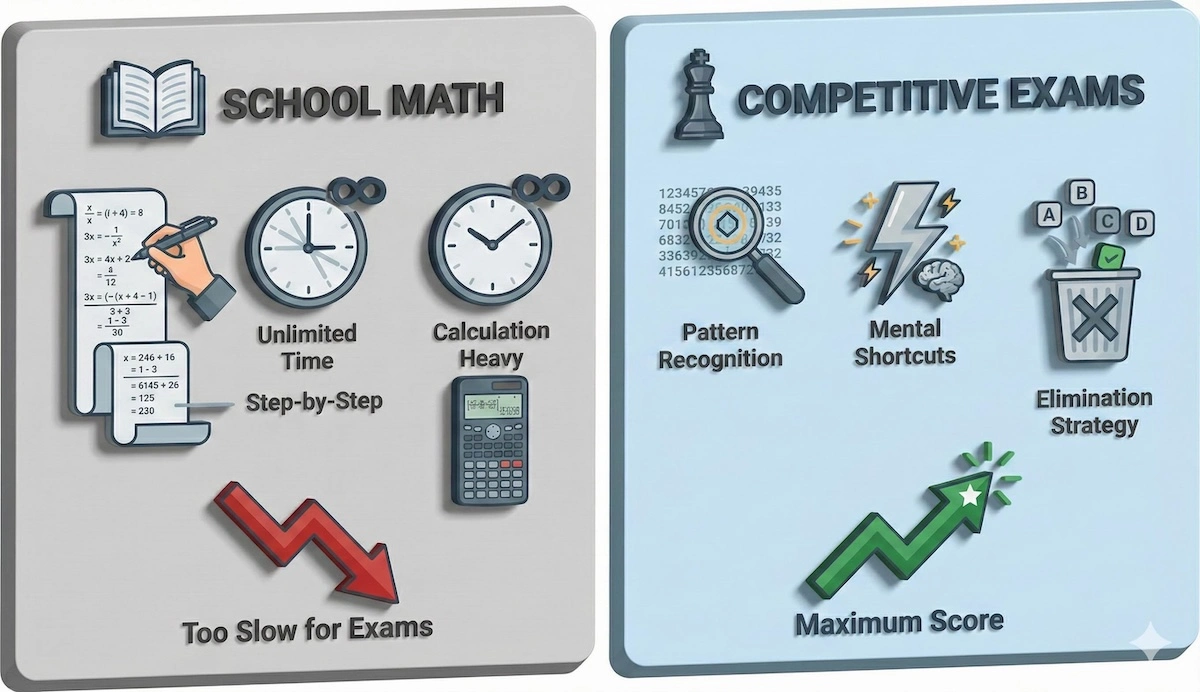
Understanding the difference between school math and exam strategy is the first step to improving your score. A specialized tutor bridges this gap, moving a student from slow calculation to fast strategic thinking.
Why Online Math Tutoring Fits Today’s Landscape
- Targets the exact blueprint — Sessions map to official frameworks (SAT modules, ACT domains, AP FRQ skills, AMC/CEMC topics), so students practice the right math — not random problem sets.
- Proven to lift scores even online — A recent randomized trial of 100% online small-group math tutoring produced sizable gains (+0.26 SD). Meta-analysis across hundreds of tutoring RCTs shows strong effects overall.
- Mirrors modern test day — Tutors rehearse with Bluebook full-length practice and the embedded Desmos calculator so the tools feel routine, not surprising.
- Builds study habits that stick — Spaced practice + retrieval practice (“test yourself”) consistently beat rereading — exactly what weekly tutoring plus quick quizzes deliver.
Students who need to solidify foundational skills before tackling exam content often benefit from working with a precalculus tutor before advancing to exam-level material. Understanding how sequences and series connect to higher math is also essential — this guide on sequences and series vs. Calculus 1 explains the relationship clearly.
How Online Tutoring Actually Transforms Performance
A. Diagnostic First: Find Hidden Weak Spots
A good onboarding assessment pinpoints:
- Concept mastery by topic
- Timing patterns and “where minutes leak”
- Error types (careless vs. conceptual vs. strategic)
- Stress responses under time
Real example: Jake in Vancouver scored 75th percentile untimed but 45th timed. His tutor spotted a pacing issue — over-checking easy problems and rushing tough ones — and rebuilt his timing plan.
B. Teach Strategic Frameworks, Not Just Steps
The POWER method (for SAT/ACT-style items):
Preview → Organize → Work backwards (if faster) → Estimate → Review.
Students learn to classify a problem quickly, choose the fastest valid path, and sanity-check results.
This framework can be difficult to visualize, so here is the POWER method broken down into a memory-friendly process.
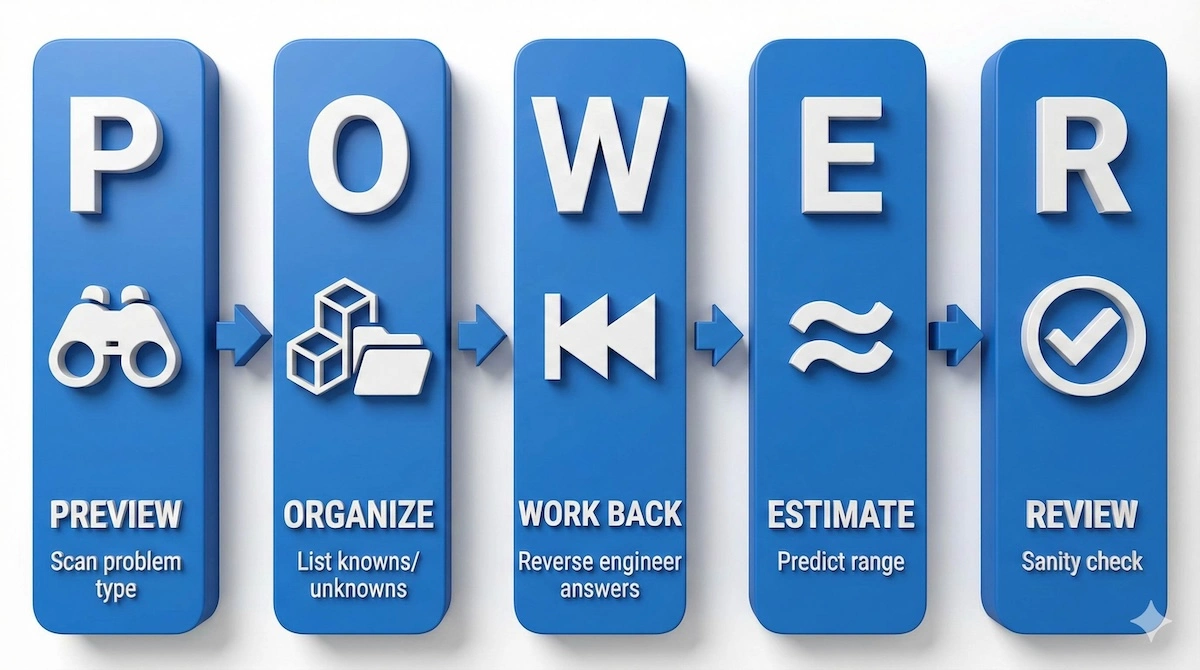
Master the POWER method to approach every complex math problem systematically and avoid panic. Memorizing this flow helps students avoid ‘blanking out’ when they see a difficult question.
C. Practice in Authentic, Tech-Enhanced Environments
- Adaptive practice that keeps challenge “just right”
- Timed blocks that simulate real pressure
- Error-pattern dashboards for targeted fixes
- Progress charts that show momentum
D. Mental-Math and Estimation Mastery (Huge Time Win)
- Squaring numbers ending in 5 (e.g., 65²=4225)
- Percentage shortcuts (15% of 80 = 10% + 5% = 8 + 4 = 12)
- Common fraction-decimal pairs (e.g., 3/8=0.375)
- Factor recognition (e.g., 143 = 11×13) — saving ~10–25 seconds per easy item buys minutes for hard ones.
Subject-Specific Strategies What Great Tutors Emphasize
- Algebra & Functions — Pattern recognition (which form? which move?) beats brute force. Example: compound-interest word problems cue immediate setup A=P(1+r)^n.
- Geometry — Dynamic diagrams > static pictures. Interactive tools help students see how changes propagate — ideal for similarity, circle theorems, coordinate geometry.
- Statistics & Probability — Data displays, experimental design, conditional probability, correlation vs. causation — tied to real contexts (sports, social data, current studies) to build judgment, not just computation.
- Advanced/Competition (AMC/CEMC) — Non-routine strategies (draw, bound, parity, invariants), contest pacing, and solution elegance from past papers.
For students moving into AP Calculus, a strong grasp of integration techniques is one of the highest-leverage skills to develop early. Students preparing for A-Level exams will also find this A-Level maths exam triage guide covering calculus and trigonometry directly relevant.
A Simple High-Impact 8-Week Plan (SAT/ACT/AP/AMC/CEMC)
Success favors the organized. Here is a week-by-week roadmap to ensure you peak exactly on exam day.
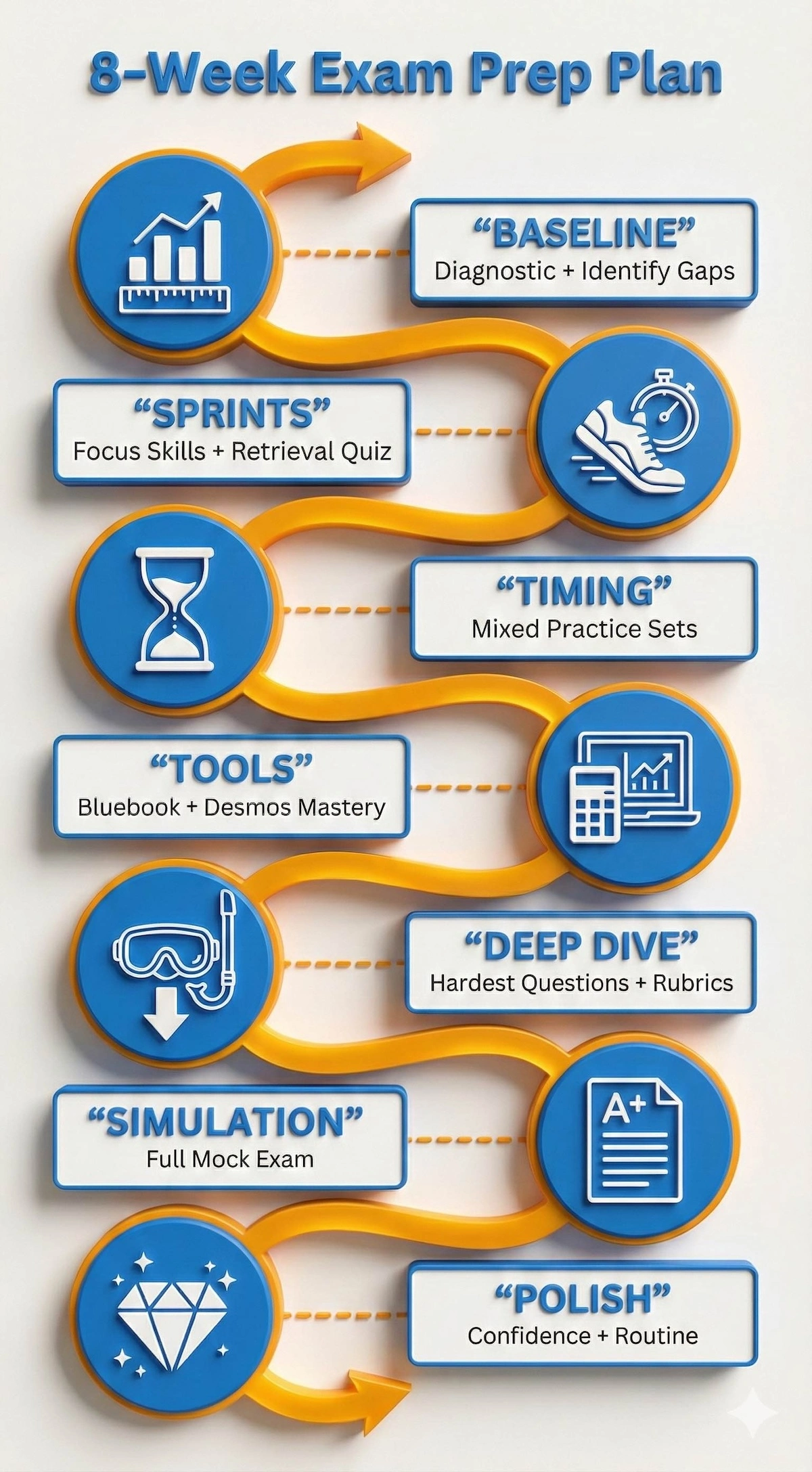
Follow this proven 8-week roadmap to peak exactly on test day without burnout. Notice how the plan shifts from learning concepts in the beginning to full simulation at the end.
Week 1: Baseline & Blueprinting
- Diagnostic aligned to target exam
- Scope: top 3 weaknesses + “quick wins”
Weeks 2–3: Core Skill Sprints
- Two focus skills/week (e.g., functions & systems; limits/derivatives; counting/number theory)
- End each session with a 10-minute retrieval quiz (spacing starts here).
Week 4: Mixed Sets + Timing
- Timed mixed practice; early pacing rules
Week 5: Application & Tools
- Digital SAT run-through with Bluebook + Desmos efficiency (trace, table, zoom)
- ACT: calculator rules + per-domain heuristics
Week 6: Exam-Specific Deep Dives
- AP: write FRQs to rubric, under time; debrief with released questions
- AMC/CEMC: non-routine sets from past contests
Week 7: Full Simulation
- Full mock with authentic tools and breaks
- Error log → micro-sessions
Week 8: Polish & Confidence
- Two short, timed sets + debrief
- Re-test weak objectives; finalize test-day routines
What Your Tutor Should Do for Each Exam at a Glance
| Exam | What it Tests Most | Tutor Focus | At-Home Practice You’ll See |
| Digital SAT Math | Algebra, functions, data in Bluebook with Desmos | Problem translation; equation↔graph links; calculator discipline | Full-length Bluebook tests; Desmos “only when needed” drills. |
| ACT Math | Algebra, geometry, functions, stats/probability | Fast item-type recognition; minimal algebra; smart guessing | Domain-tagged mixed sets + 5-min speed bursts. |
| AP Calculus AB | Limits, derivatives, integrals; FRQ justification | “Show work” logic; units; graph interpretation | Weekly mini-FRQs scored to rubric + one FRQ lab. |
| AP Statistics | Data collection, inference, modelling; FRQs | Assumptions language; context-based inference | Short “explain the inference” prompts + FRQ practice. |
| AMC/CEMC | Non-routine problem-solving | Heuristics (draw, bound, parity); contest pacing | Past contest sets with reflection notes. |
A Parent’s Guide to Choosing Effective Online Tutoring
Red flags (skip these):
- One-size-fits-all curriculum
- No diagnostic (or only a grade-level test)
- No timed practice under realistic conditions
- No tutor track record with your target exam
- No progress tracking or adaptive difficulty
Green flags (seek these):
- Exam-specific curriculum with documented results
- Diagnostic that surfaces performance patterns (not just topics)
- Tutors with competitive-exam expertise
- Technology that improves learning (not just a video call)
- Transparent dashboards + regular parent updates
Keep this checklist handy when you are interviewing potential tutors to make sure you hire a pro.
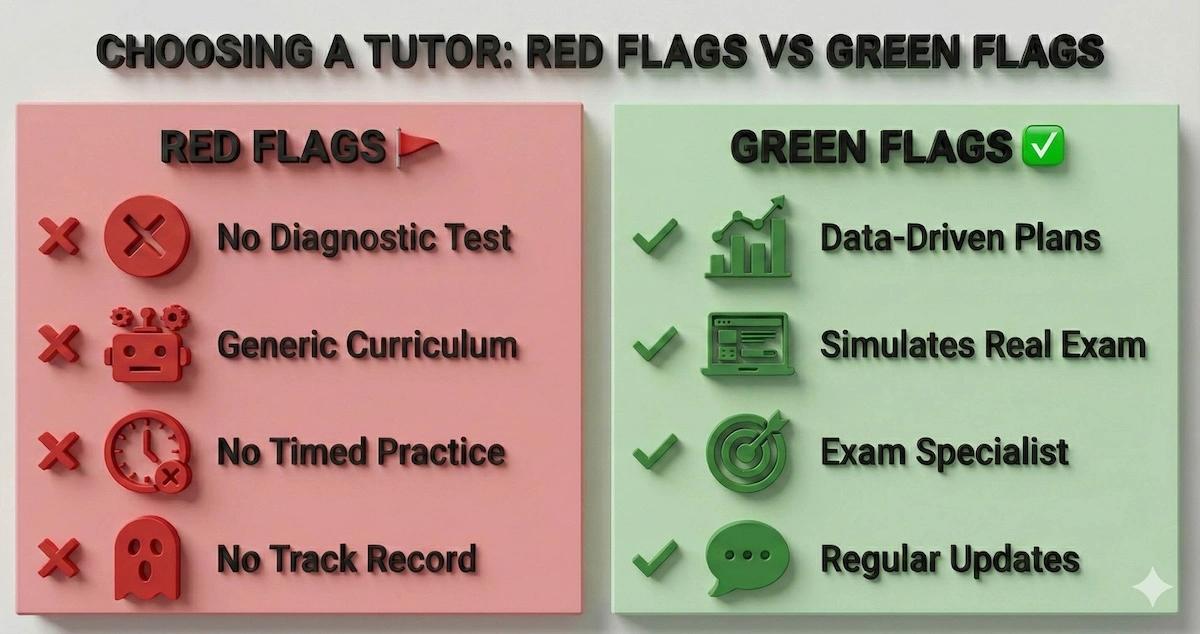
Use this checklist when interviewing potential tutors to ensure you’re getting quality exam preparation. If a tutor hits the red flags, it’s safer to keep looking.
Questions to ask:
- “What’s your average score gain for this exam?”
- “How do you personalize from the diagnostic?”
- “How will you simulate the real exam (Bluebook/Desmos/ACT timing)?” (Bluebook, SAT Suite, ACT)
- “References from similar students?”
- “How do you adjust for test anxiety or pacing issues?”
How to Choose Online Math Tutoring Services by Goal
- AoPS (Art of Problem Solving) — Best for contest math/advanced enrichment (deep problem solving; Alcumus; live online classes).
- Wyzant (Marketplace) — Best for flexibility & budget control; wide range of independent tutors.
- Skooli — Best for on-demand help (per-minute model; hour packs).
- Sylvan — Best for structured programs (incl. SAT/ACT).
- Paper (school-provided) — Best zero-cost option if your district subscribes. (Interview any service using the “Questions to ask” list above.)
With so many options, it helps to see them side-by-side. Here is how the top platforms compare by goal and cost.
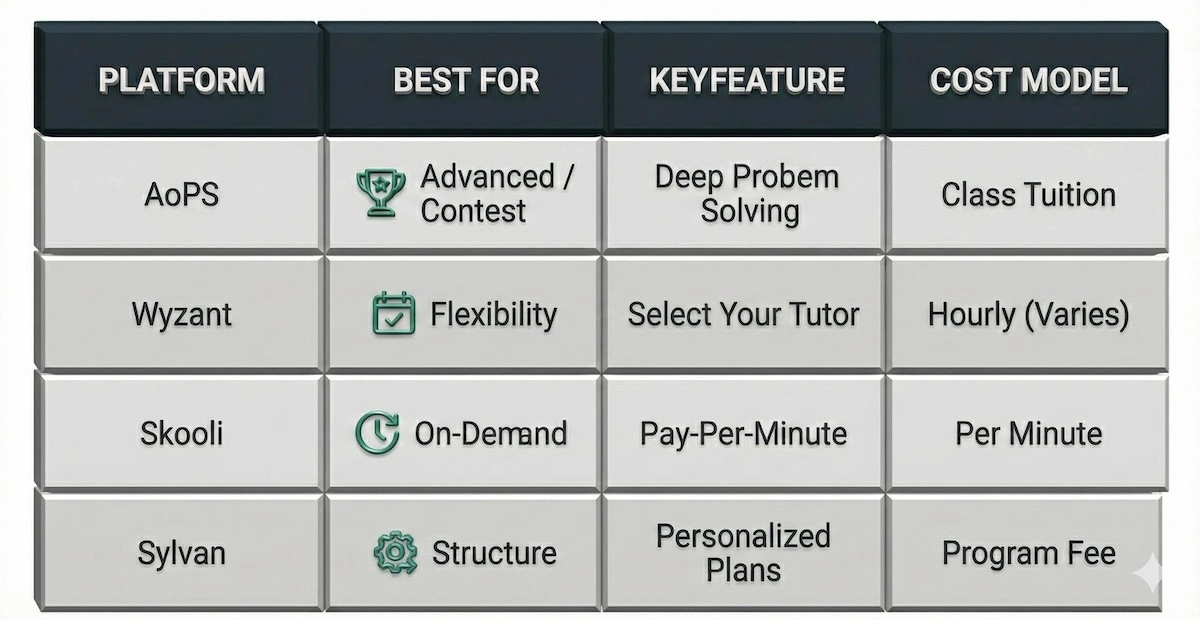
Compare the top math tutoring options at a glance to find the right fit for your student’s goals. Choose the model that fits your student’s specific learning style and your budget.
Budgeting: Transparent and Simple
| Scenario | Assumptions | Estimated Cost |
| Marketplace (Wyzant) | 1.5 hrs/week × 8 weeks at $35–$60/hr | $420–$720 total (tutors set rates) |
| On-demand (Skooli) | 75 min/week × 8 weeks at $0.65–$0.83/min | $390–$498 total (hour packs available) |
| Program (Sylvan) | 1 hr/week × 8 weeks at $49+/hr | $392+ total (location varies) |
Tip: Mix formats — e.g., weekly marketplace sessions + a Skooli “hotline” for last-minute questions — to control cost while keeping momentum.
The Essential Toolkit and Why It Matters
- Bluebook full-length SAT practice → authentic timing + tools. (Bluebook)
- Desmos (College Board version) → replicate the on-screen calculator exactly. (Desmos)
- Official ACT Math guidance → drills align to real blueprints. (ACT)
- Released AP FRQs → write to rubric under time. (AP Central)
- AMC/CEMC past contests → build non-routine problem-solving. (Mathematical Association of America, CEMC)
Students who want to go deeper into calculus-level exam content will find this first exam guide for statics a useful companion for understanding how rigorous exam expectations are structured. For students who want to explore calculus as a subject in its own right, working with an online calculus tutor can accelerate both exam readiness and long-term mathematical fluency.
Quick-Start Checklist
- Choose a tutor who can mirror your test’s environment (Bluebook/Desmos; ACT timing). (Bluebook, ACT)
- Agree on an 8-week scope with two focus skills/week + retrieval quizzes. (pdf.retrievalpractice.org)
- Schedule one full simulation two weeks out.
- Keep a shared error log to convert mistakes into targeted drills.
Common Parent Mistakes and Easy Fixes
#1 Starting too late → Begin with diagnostics early; ramp up strategy closer to test dates.
#2 Only chasing weak areas → Maintain strengths and fix gaps; avoid backsliding.
#3 Too many practice tests, too little analysis → Deep-dive every test; train the pattern, not just the page count.
The Near Future of Online Math Learning
AI-driven diagnostics, richer visual tools (even VR for geometry), and global peer practice communities are redefining what “prep” can be. The skills students build — problem solving, data sense, tech-fluency — pay off far beyond test day.
Students who want to strengthen their analytical foundations alongside exam prep may also benefit from working with a real analysis tutor to develop rigorous mathematical reasoning. For those whose exam prep involves data-heavy subjects like AP Statistics, exploring RStudio tutoring can build the computational fluency that modern exams increasingly reward.
Wrap-Up: The Real Advantage
The difference between students who excel and those who plateau isn’t raw ability — it’s specificity: practicing the right skills, in the real environment, with research-backed routines that stick. That’s what strong online math tutoring delivers.
Remember Sarah’s daughter from Toronto? Six months of strategic online tutoring, +140 on SAT Math, and — more importantly — lasting confidence that now fuels tough university courses.
First step: book a diagnostic, pick a service that mirrors your exam, and start the 8-week plan above. Your child’s momentum can start this week.
Frequently Asked Questions About Online Math Tutoring for Competitive Exams
How long should my child study with an online math tutor to prepare for competitive exams like SAT or ACT?
Most students benefit from 8–12 weeks of tutoring. Moderate SAT improvements (100–150 points) require 40–60 total hours (2–3 hours/week). Larger gains (200–300 points) may need 4–6 months. High scorers may need shorter, intensive sessions. Consistency is key.
Is online math tutoring as effective as in-person tutoring for competitive exam preparation?
Yes. Online math tutoring is equally effective for competitive exam preparation, offering benefits like digital practice mirroring tests, instant feedback, progress tracking, and access to specialized tutors anywhere. Effectiveness depends on tutor expertise in competitive exams.
How much does online math tutoring cost for competitive exam preparation?
Rates range from $30–$80/hr for general tutoring and $80–$150+ for specialized test prep. Group sessions cost $20–$40/hr. 40 hours of SAT prep may cost $1,200–$3,200 depending on tutor experience. Trial sessions and packages are often available.
What qualifications should I look for when choosing an online math tutor for competitive exams?
Look for proven test expertise, high personal scores (SAT 1500+, ACT 34+), 2–3 years test prep experience, knowledge of official resources, and strategic teaching. Avoid tutors with unrealistic score promises.
Can online math tutoring help my child build confidence for high-pressure competitive exams?
Yes. Online math tutors gradually introduce timed practice, track progress, and provide one-on-one guidance to reduce anxiety, build competence, and strengthen test-day confidence.
How do I choose between group and one-on-one online math tutoring for competitive exams?
- One-on-one: Best for weak areas, high scores, or test anxiety.
- Group: Good for motivated students with solid foundations and budget constraints.
- Hybrid: Combine both — start individual, then join group sessions for practice.
What is the difference between general math tutoring and specialized competitive exam preparation?
General math tutoring builds school-level understanding. Competitive exam preparation focuses on test-specific content, strategies, pacing, and practice under timed conditions to maximize scores.
How can online math tutoring address my child’s test anxiety for competitive exams?
Online math tutors identify anxiety triggers, use gradual timed practice, teach coping strategies, and provide consistent feedback to build confidence and reduce stress under exam conditions.
What technical requirements are needed for effective online math tutoring sessions?
Stable internet, laptop/desktop, webcam, microphone/headphones, optional stylus/tablet, quiet well-lit space, and access to video conferencing and digital whiteboards.
How long does it typically take to see score improvements from online math tutoring?
Initial gains appear in 4–6 weeks. Significant improvements take 2–3 months with consistent practice. Full-length tests, error review, and daily practice accelerate progress. Maintenance is needed before the exam to prevent skill decay.
Related Reading
******************************
This article provides general educational guidance only. It is NOT official exam policy, professional academic advice, or guaranteed results. Always verify information with your school, official exam boards (College Board, Cambridge, IB), or qualified professionals before making decisions. Read Full Policies & Disclaimer , Contact Us To Report An Error