Physics Tutoring Costs in 2026: Real Rates, Hidden Fees Explained

- Physics tutoring rates in 2026 range from $15/hr to $160/hr depending on format and qualification.
- Hidden fees — cancellation, travel, package minimums — add 30–50% above the advertised rate.
- Online tutoring is consistently 30–60% cheaper than equivalent in-person formats.
- A 20-hour exam prep block costs $520–$3,000 depending on tutor tier and format.
- Volume commitments and off-peak scheduling reliably produce 10–20% rate reductions.
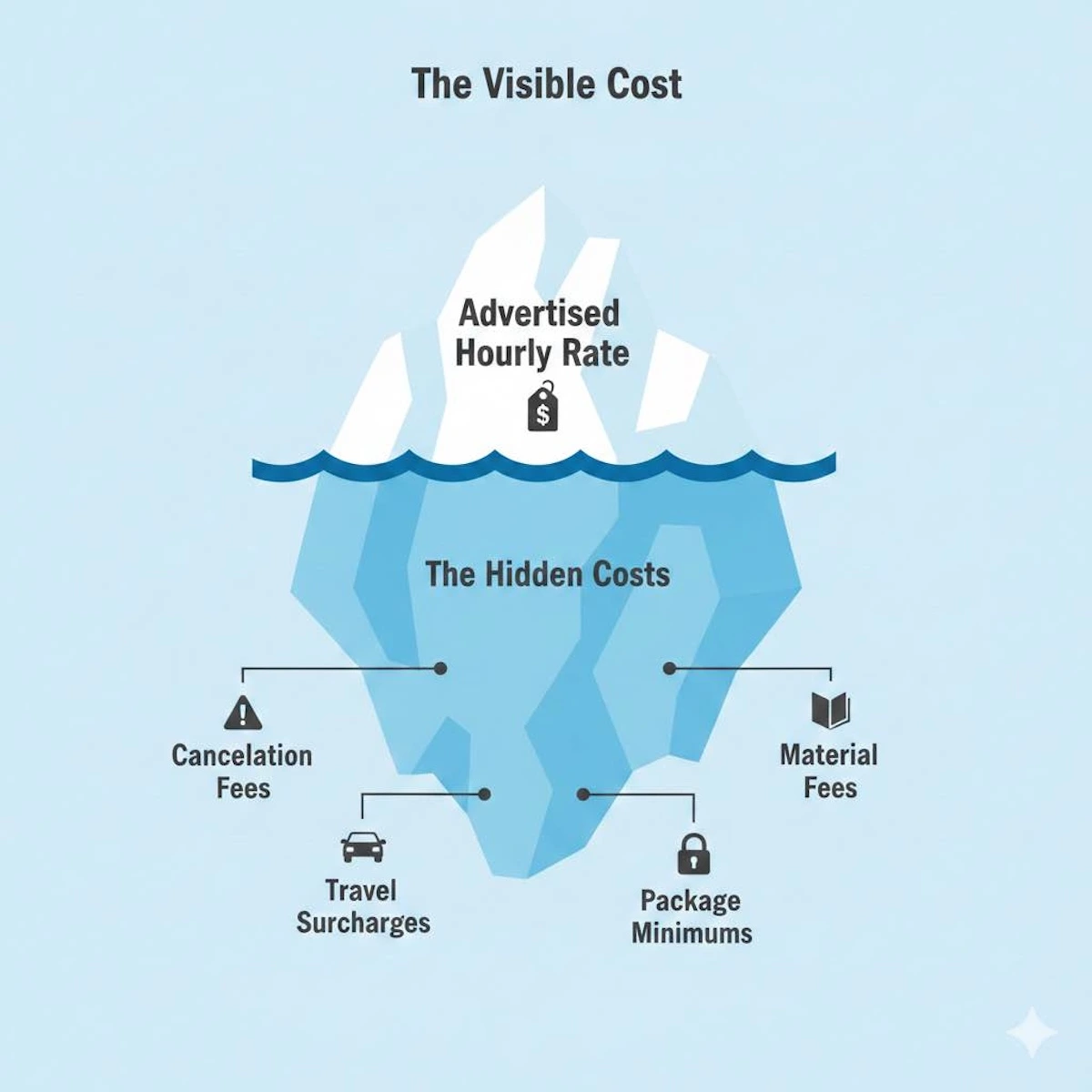
Physics tutoring costs range from $0 to $160 per hour in 2026, depending on format, tutor qualification, and where you live. The advertised hourly rate is only the beginning. Cancellation penalties, package minimums, travel surcharges, and materials fees routinely push the real total 30–50% above what students see on a tutoring platform’s pricing page. This guide gives you every number you need before you commit to a single session.
The sections below cover verified regional benchmarks across four countries, a full breakdown of six categories of hidden fees, a side-by-side format comparison table, a worked cost example for a 20-hour exam prep block, and a practical negotiation guide built from patterns students who consistently get stuck on pricing conversations can actually use.
If you are comparing online physics tutors for AP Physics, university-level mechanics, or advanced electromagnetism, the data here will tell you whether the rate you’ve been quoted is normal, inflated, or a red flag.
Global Physics Tutoring Rates at a Glance
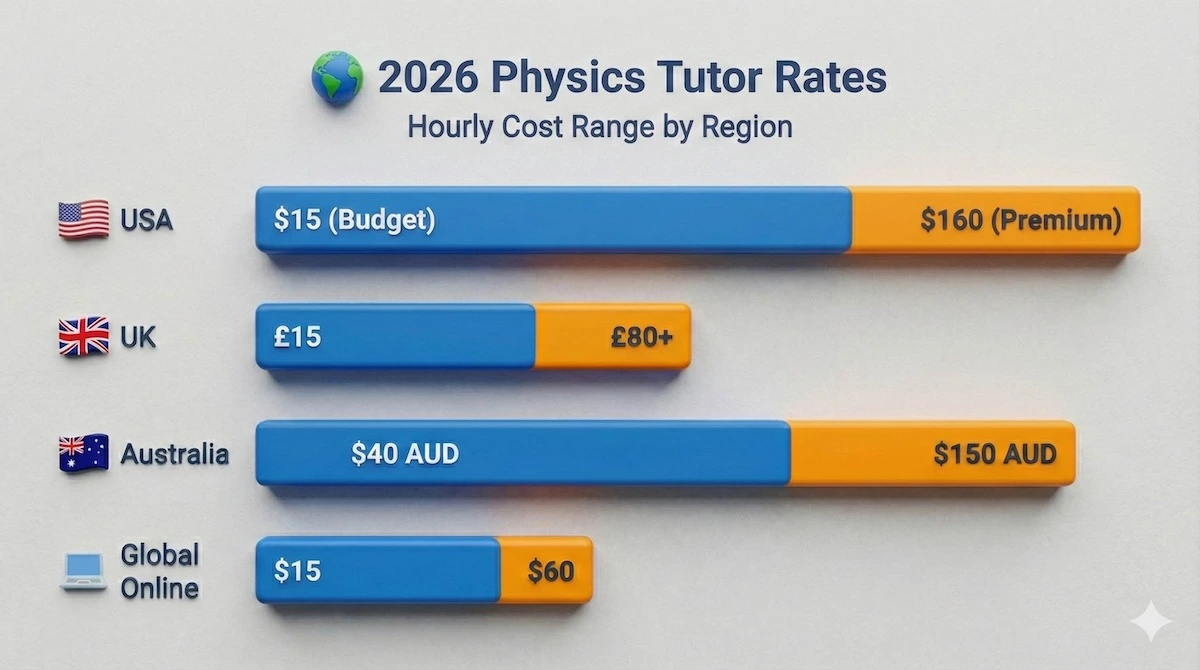
Physics tutor rates vary by country, platform, and session format. The table below consolidates verified 2026 market ranges across the four regions where MEB students are most concentrated. Use it as your baseline before evaluating any specific quote.
| Region | Budget Range | Mid-Range | Premium / Specialist | Typical Format |
|---|---|---|---|---|
| United States | $15–$40/hr | $40–$80/hr | $80–$160/hr | Online dominant; in-person in metro areas |
| United Kingdom | £15–£30/hr | £30–£55/hr | £55–£80/hr | Mixed; London adds 20–35% premium |
| Australia | AUD $40–$70/hr | AUD $70–$110/hr | AUD $110–$150/hr | Online growing; strong in-person market in Sydney/Melbourne |
| India | ₹300–₹800/hr | ₹800–₹1,500/hr | ₹1,500–₹3,000/hr | Online dominant; JEE/NEET specialist premium applies |
| Global Online Platforms | $15–$30/hr | $30–$60/hr | $60–$120/hr | Wyzant, Preply, Tutor.com, MEB — varies by tutor profile |
Per KIS Academics’ 2025 tutor rate breakdown, online physics tutors in the US average $40–$60 per hour at the mid-market level, with strong regional variance: New York and San Francisco tutors command rates 25–40% above the national median, while tutors in the Midwest or rural Southeast often price below $40/hr for comparable qualifications.
United States
US physics tutor pricing breaks down into three clear tiers. Undergraduate or recent-graduate tutors on peer platforms (Chegg Tutors, Wyzant student profiles) typically charge $15–$35/hr. Verified teachers or graduate students with subject-specific physics credentials range from $40–$80/hr. PhD-level tutors or AP exam specialists with documented pass-rate track records charge $80–$160/hr, sometimes more for intensive one-week exam prep packages.
United Kingdom
UK private physics tuition rates are benchmarked by qualification: A-Level tutors without university teaching experience average £20–£35/hr; those with undergraduate physics degrees or secondary school teaching experience charge £35–£55/hr; tutors with Oxford or Cambridge affiliations or documented Oxbridge admissions coaching experience often exceed £65/hr. London adds a structural premium of 20–35% across all tiers due to demand concentration.
Students preparing for A-Level exams can find a dedicated A-Level Physics tutor to work through the specific content and exam technique their qualification demands.
Australia
Australian tutoring rates are higher in absolute terms than comparable US rates, partly due to minimum wage structures that affect what self-employed tutors consider acceptable hourly income. Budget tutors in Perth or Adelaide average AUD $40–$60/hr; Sydney and Melbourne tutors cluster at AUD $70–$110/hr for mid-level qualifications. HSC Physics specialists with proven trial exam results routinely charge AUD $120–$150/hr in metropolitan areas.
India
India’s physics tutoring market is bifurcated between general coaching for CBSE/ICSE curricula and highly competitive JEE/NEET specialist coaching. General tutors charge ₹300–₹800/hr. JEE Advanced specialists from IIT-background institutes command ₹2,000–₹3,000/hr or more, with package-only pricing common. Online platforms have compressed general-tier rates but haven’t significantly affected specialist coaching premiums.
Why Physics Tutoring Costs So Much More Than You’d Expect
Five structural factors drive physics tutor rates above what students typically budget for, and understanding each one tells you where you have negotiating leverage and where you don’t.
1. Tutor Qualification Premium
Physics is one of the highest-premium subjects in private tutoring markets. Unlike math tutors, who can often coach to curriculum with strong procedural knowledge, physics tutors must bridge mathematical formalism, physical intuition, and problem-framing — a combination that demands genuine subject mastery. A verified physics PhD who can diagnose why a student keeps getting the wrong sign on normal force problems commands a rate premium of 40–80% over a generalist STEM tutor with similar hours of tutoring experience.
2. Specialization Markup
AP Physics C (Mechanics and Electricity & Magnetism), university-level quantum mechanics, and condensed matter topics carry explicit specialization markups of 20–50% above a tutor’s base rate. Students researching condensed matter physics tutoring will find that qualified tutors in this niche charge at or above the premium tier in every region. When demand for a specific sub-topic exceeds available tutor supply, rates follow accordingly.
3. Session Duration Economics
Most tutors price 60-minute sessions as their base unit, but many students request 90-minute or 2-hour blocks for exam prep. The rate per hour is rarely proportional: tutors who charge $60/hr for a 60-minute session often charge $100–$110 for a 90-minute session (an effective $67–$73/hr rate), because setup time, cognitive load, and problem-set preparation don’t scale linearly. A 2-hour session at a discounted rate of $110 still costs more per session than two separate 60-minute sessions at $60 each.
4. Online vs. In-Person Cost Gap
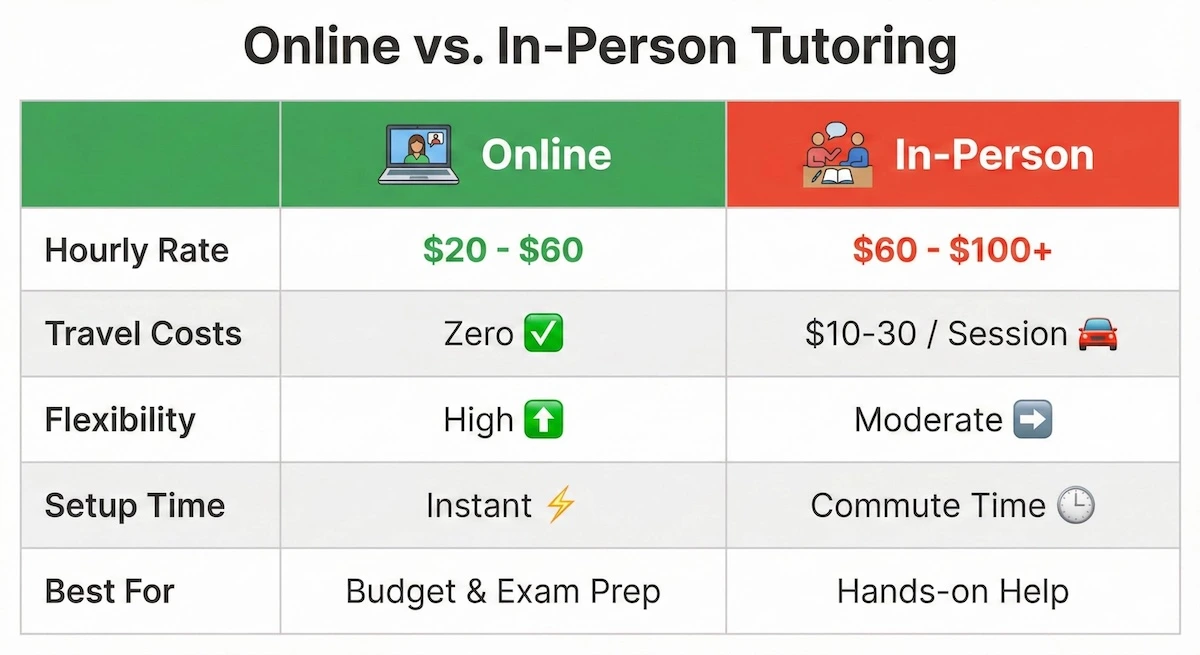
In-person physics tutoring adds a structural cost layer that online sessions eliminate. Travel time, whiteboard and material logistics, and the tutor’s effective hourly rate including transit push in-person rates 30–60% above comparable online sessions. Per market data from tutoring platforms, a tutor offering $45/hr online will typically charge $65–$75/hr for in-person sessions with the same student, in the same city.
5. Regional Price Variation (Even Within Countries)
City-level variation within a single country can exceed country-level variation between markets. A physics tutor in rural Ohio charges roughly the same as a mid-range London tutor. Manhattan, London Zone 1, Sydney CBD, and Bangalore’s tech corridors all carry 25–50% city premiums over their national averages. Students outside major metro areas often access better value through global online platforms than through local in-person markets.
Hidden Fees That Increase Your Total Cost
The six fee categories below are routinely omitted from platform listings and tutor introductory emails, but they appear on invoices. Knowing them before you agree to a tutor arrangement puts you in a position to ask about each one explicitly or to walk away when the answers are unsatisfactory.
Cancellation Penalties
Cancellation policies range from “24 hours notice required” to “full session fee charged for cancellations under 48 hours.” On platforms like Wyzant, platform-level cancellation protection does not always override individual tutor policies listed in their profile fine print. A student who cancels two sessions in a 10-week block could lose $80–$200 in fees that produce zero learning time. Always confirm the exact cancellation window and whether the fee is a full-session charge or a flat penalty before your first session.
Package Minimums
Many tutors and tutoring agencies require minimum package purchases of 5, 10, or 20 hours. A $60/hr tutor who requires a 10-hour minimum upfront commit means $600 is on the table before you know if their teaching style works for you. Trial sessions (typically 30–60 minutes at a reduced or full rate) exist precisely to mitigate this risk but not all tutors offer them. Ask explicitly: “Do you offer a single trial session before committing to a package?”
Materials and Test-Prep Fees
Some tutors include materials in their hourly rate; others bill separately for past papers, solution sets, custom problem sheets, or third-party test prep books they recommend. Additional materials fees of $20–$80 per exam prep block are common. Clarify upfront whether the quoted rate is “all-in” or whether materials are invoiced separately.
Travel Fees (In-Person Tutoring)
Travel fees for in-person tutoring are often framed as a per-session fixed charge or a per-kilometer/mile rate. In practice, travel fees of $10–$30 per session are standard in urban areas where tutors travel by transit or rideshare. Over a 20-session block, this adds $200–$600 in total cost — enough to shift the cost comparison decisively toward online tutoring for most students.
Registration, Setup, or Onboarding Fees
Platform-side fees are separate from tutor fees. Some tutoring agencies charge a registration or onboarding fee of $25–$75 to access their tutor pool. This is disclosed at signup but is often overlooked in initial cost comparisons. If a platform charges this fee, factor it into your cost-per-hour calculation for shorter engagement periods.
Trial Lesson Pricing
Trial lessons are priced inconsistently. Some tutors offer a free 15-minute consultation call; others charge a full session rate for the first lesson, framed as a “trial.” A small number offer a genuine discounted trial at 50–70% of the standard rate. Knowing this range means you can ask for a discounted trial as a standard request — many tutors will agree if asked, and few volunteer the option proactively.
Physics Tutoring Format Comparison: True Cost Breakdown
The format you choose determines your total cost more than any other single variable. The table below compares five common physics tutoring formats across four cost dimensions, using 2026 market rates.
| Format | Typical Hourly Rate | Hidden Fee Risk | Flexibility | Best For |
|---|---|---|---|---|
| Online freelance (e.g., Wyzant) | $20–$80/hr | Low–Medium | High | Most students; easy to switch tutors |
| Online tutoring agency | $40–$120/hr | Medium (package minimums + platform fees) | Medium | Students who need a guaranteed curriculum track |
| In-person independent | $50–$100/hr | High (travel + materials + cancellation) | Low | Students who need hands-on whiteboard collaboration |
| Tutoring center / franchise | $60–$130/hr effective | High (enrollment, materials, package lock-in) | Low | Younger students; structured recurring schedule |
| Group online sessions | $10–$30/hr per student | Low | Medium | Exam prep with peers; budget-constrained students |
Comparing Online vs. In-Person: True Cost Breakdown
Online physics tutoring costs $20–$60/hr at the mid-range in 2026; in-person tutoring in the same market costs $60–$100/hr or more. The gap is real, but the format choice also affects session quality, accountability, and the type of problems a tutor can walk through effectively. Here is what the true cost comparison looks like when all variables are counted.
| Cost Element | Online (20 sessions) | In-Person (20 sessions) |
|---|---|---|
| Base tutor rate ($50/hr online; $75/hr in-person) | $1,000 | $1,500 |
| Travel fees ($0 online; $15/session in-person) | $0 | $300 |
| Materials | $30 | $60 |
| Platform fee (one-time) | $0–$50 | $0 |
| Estimated cancellation cost (1 session) | $50 | $75–$90 |
| Estimated Total | $1,080–$1,130 | $1,935–$1,950 |
The format difference in this example produces a $800–$870 swing in total spend before session quality or tutor fit is considered. Students who learn effectively in digital environments using shared screen, digital whiteboards, and asynchronous problem-set review gain both financially and logistically from online tutoring.
For students who consistently work better with physical presence, the premium for in-person is real but may produce better outcomes per dollar spent. Read the full breakdown on condensed matter physics tutoring online to evaluate which format matches your learning profile.
Free and Low-Cost Alternatives to Paid Tutoring
Before committing to a paid tutor, confirming which free and low-cost options you have already exhausted is a necessary budget step — not an optional one. Several alternatives match or exceed mid-tier paid tutoring for students who can self-direct and identify their specific confusion points.
Completely Free
- Khan Academy Physics — Full AP Physics 1 and 2 coverage with worked examples and practice exercises. Strongest for foundational mechanics and kinematics.
- MIT OpenCourseWare (8.01, 8.02) — Full lecture videos, problem sets, and exams from MIT’s introductory physics sequence. Suitable for university-level students who need rigor.
- Professor Leonard (YouTube) — Long-form physics lecture series covering calculus-based mechanics, thermodynamics, and more. Over 1M subscribers; conceptually thorough.
- University physics office hours — Included in tuition; the most underutilised free resource available to enrolled students.
- Physics Stack Exchange — Expert community Q&A for conceptual and problem-solving questions; fastest for targeted confusion points.
Low-Cost or Freemium
- Chegg Study ($15.95/mo) — Textbook solution access and a Q&A board with response times under 2 hours. Not a substitute for worked sessions, but useful for homework verification.
- Coursera audit mode — Most physics courses on Coursera can be audited free of charge; graded assignments require a paid subscription ($49–$79/mo).
- Group session platforms — Platforms like Study.com and Numerade offer monthly subscriptions ($20–$35/mo) that include video explanations and some live support.
Why Some Students Still Pay
Free resources don’t diagnose.
A student who keeps getting the wrong answer on free body diagram problems isn’t helped by another video explaining free body diagrams. What they need is a tutor who watches them work through a problem in real time, identifies the specific step where their setup breaks down, and corrects it at that level.
That diagnostic interaction is what paid physics tutoring actually provides — and it’s the part no free resource replicates. For more strategies on getting more out of your study time before or between sessions, see why physics homework takes so long and how to fix it.
Real-World Example: Total Cost of Exam Preparation
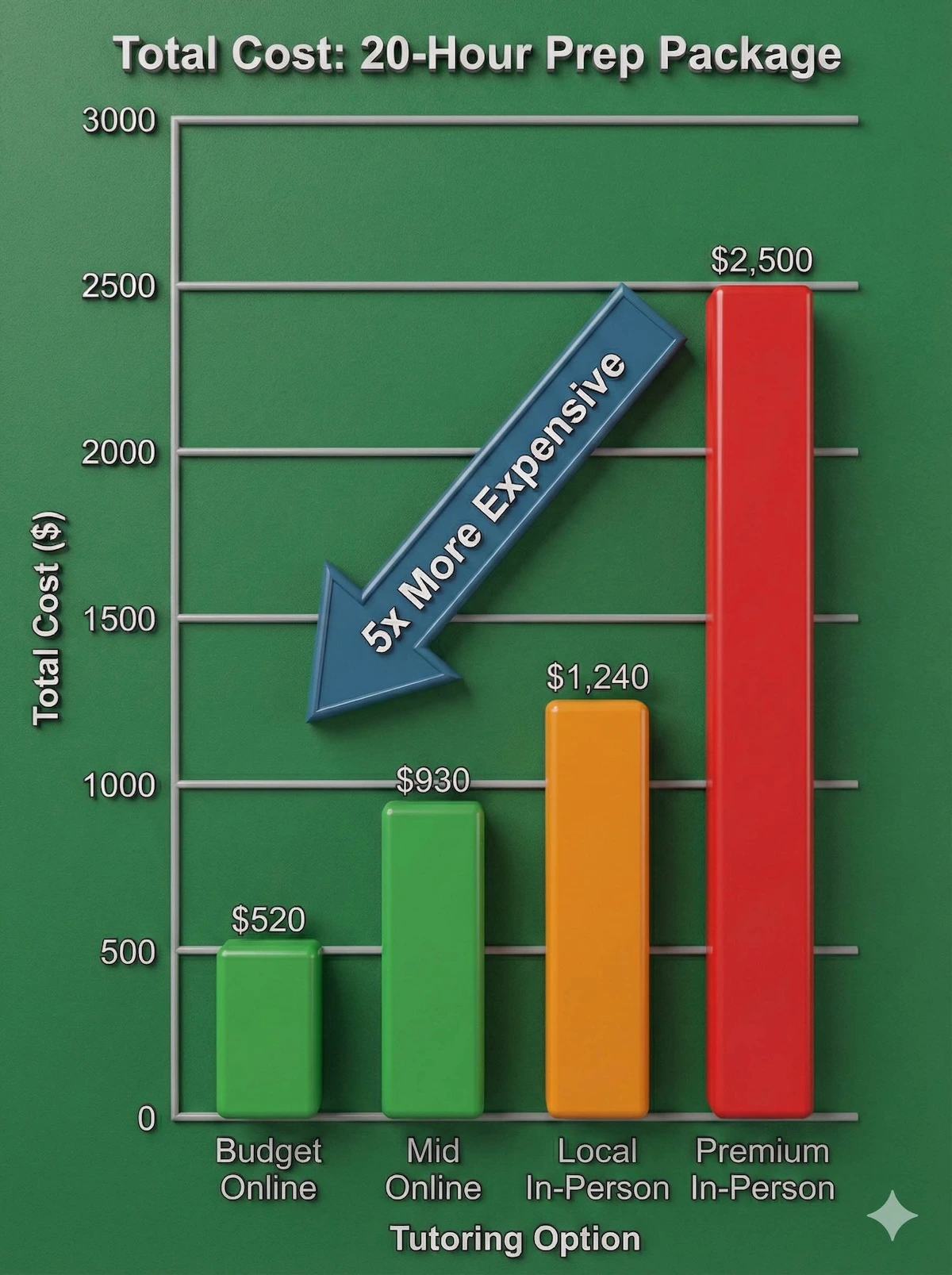
A 20-hour physics exam prep block is the most common tutoring engagement students purchase before AP exams, university finals, or standardised tests. The cost difference between the budget and premium approach is significant.
| Scenario | Tutor Rate | Format | Hidden Fees (est.) | Total Cost |
|---|---|---|---|---|
| Budget Online | $22/hr | Online freelance | $80 (platform + materials) | ~$520 |
| Mid-Range Online | $55/hr | Online agency | $150 (platform + 1 cancellation) | ~$1,250 |
| Premium In-Person | $100/hr | In-person specialist | $500 (travel + materials + 1 cancellation) | ~$2,500 |
| PhD Specialist (US) | $140/hr | Online private | $200 (materials + deposit) | ~$3,000 |
The 5x price gap between budget and premium options is real. But the relevant question isn’t which scenario costs less — it’s which produces the outcome you need within your deadline. A student six weeks from an AP Physics C exam who has already worked through the curriculum independently may extract more value from a premium 20-hour block with a specialist than a 40-hour block at budget rates with a generalist.
Students preparing specifically for AP Physics 1 can find targeted support from an AP Physics 1 tutor whose focus matches the exam’s scope. The format premium for in-person adds cost without proportionally adding outcome for most university students.
Regional Benchmark: What’s Normal to Pay?
Regional benchmarks give you a reference point when evaluating whether a specific quote is reasonable. The table below defines “normal” ranges for physics tutoring by region and level in 2026.
| Region / City | High School Level | AP / A-Level / HSC | University Undergraduate | Graduate / Specialist |
|---|---|---|---|---|
| USA — National Average | $25–$50/hr | $45–$80/hr | $50–$100/hr | $80–$160/hr |
| USA — NYC / SF / LA | $40–$70/hr | $65–$110/hr | $75–$130/hr | $110–$160+/hr |
| UK — National Average | £18–£35/hr | £30–£55/hr | £35–£65/hr | £55–£80/hr |
| UK — London | £25–£45/hr | £40–£70/hr | £50–£80/hr | £70–£100+/hr |
| Australia — Sydney / Melbourne | AUD $50–$80/hr | AUD $75–$115/hr | AUD $90–$130/hr | AUD $120–$150/hr |
| India — JEE/NEET Specialist | ₹400–₹800/hr | ₹1,000–₹2,000/hr | ₹1,500–₹2,500/hr | ₹2,000–₹3,000+/hr |
| Global Online (any region) | $15–$35/hr | $25–$60/hr | $35–$80/hr | $60–$120/hr |
If a quote you’ve received falls above the “Specialist” column for your region and level, ask the tutor to specify what qualifies the rate — documented pass rates, institutional affiliation, or peer-reviewed credentials. A rate above the regional benchmark is not automatically unjustified, but it requires a verifiable reason.
Factors That Actually Affect Tutor Quality (Beyond Price)
Price and quality are correlated in physics tutoring, but weakly. A $120/hr tutor is not automatically better than a $55/hr tutor for your specific situation. The four factors below predict tutoring effectiveness more reliably than the hourly rate alone.
Subject specificity: A tutor with a physics degree and documented AP Physics C teaching history will outperform a general STEM tutor at the same rate for AP Physics C, almost without exception. The more specific your need, the more specific the tutor’s background should be.
Diagnostic approach: Effective physics tutors ask students to work through a problem from scratch in the first session — then watch silently before intervening. Tutors who explain before observing the student’s process often miss the actual error pattern. Ask any prospective tutor: “How do you identify where a student’s understanding breaks down?”
Session structure: The best sessions combine a short concept review (10–15 minutes), active problem-solving with the student leading (30–40 minutes), and targeted error correction with a self-correction exercise (10–15 minutes). If a tutor cannot describe their session structure clearly, their sessions may not be structured at all.
Documented outcomes: Pass rates, grade improvements, or specific exam results are the highest-value quality signals available. Not all tutors track these, but those who do and share them give you verifiable evidence rather than testimonial claims. Ask: “Can you share any documented student outcomes from the past 12 months?”
Students comparing AP Physics options can also explore what an AP Physics tutor brings to exam preparation versus a general physics tutor.
How to Negotiate Physics Tutoring Rates
Physics tutor rates are more negotiable than most students assume — particularly for longer engagement blocks, off-peak scheduling, or when you bring a specific, well-defined problem rather than a vague subject area. Students who approach pricing conversations without a specific ask routinely overpay relative to students who arrive with data.
Leverage Points
- Commit to volume upfront: Tutors prefer certainty. Offering a 10-session commitment in exchange for a 10–15% rate reduction is a trade most independent tutors will accept.
- Offer off-peak scheduling: Morning slots on weekdays are typically 15–20% lower than evening or weekend slots for independent tutors, because demand is lower and they’re filling dead time.
- Bring a well-defined problem: “I need help with AP Physics C Mechanics, specifically Lagrangian mechanics and rotational dynamics, for the May exam” allows a tutor to prep efficiently. Defined scope = faster results = lower effective per-outcome cost.
- Ask about group rates: If you have two or three peers with the same exam pressure, a group session at $20–$25/hr per student is often achievable for a tutor who would otherwise charge $60/hr individually. A 3-student group session at $70/hr total costs each student less than $25/hr.
What Won’t Work
- Asking for a discount without offering something in return (certainty, volume, timing).
- Comparing a specialist tutor’s rate to a platform’s base rate without acknowledging qualification differences.
- Requesting free sessions or “trial exams” beyond the standard 15–30 minute consultation. Most tutors will decline, and it damages the negotiating relationship.
For students weighing whether AP Physics 1 fluids topics justify specialist rates, the breakdown of AP Physics 1 fluids difficulty per question gives useful context on where specialist knowledge matters most.
Alternatives to Paid Physics Tutoring: Side-by-Side Comparison
Not every student needs a paid physics tutor. The table below compares paid tutoring against five categories of alternatives across four decision dimensions, so you can make a structured choice rather than a default one.
| Option | Cost | Personalization | Real-Time Feedback | Best Situation |
|---|---|---|---|---|
| Paid 1-on-1 Tutor | $20–$160/hr | High | Yes | Complex diagnostic need; exam deadline pressure |
| University Office Hours | Free | Medium | Yes (limited time) | Specific assignment confusion; enrolled students |
| Khan Academy / MIT OCW | Free | Low | No | Foundational gaps; self-directed learners |
| Chegg Study / Numerade | $15–$35/mo | Low–Medium | Limited | Homework verification; solution checking |
| Group Study Sessions | Free or $10–$25/hr | Low | Peer-level | Problem-set review; students at same level |
| Physics Stack Exchange | Free | Medium (if well-posed) | Asynchronous | Specific conceptual questions; well-defined problems |
The honest conclusion from this comparison: paid tutoring is justified when you have a diagnosed error pattern you can’t resolve independently, a fixed deadline (exam in 2–6 weeks), and sufficient budget to sustain at least 8–10 sessions. For students who haven’t yet exhausted free resources or who are still identifying their specific confusion points, starting with office hours and structured free resources is the rational first step.
Students considering A-Level Physics support can also read about how to conquer A-Level Physics and why it’s worth the challenge before deciding whether paid tutoring is the right next step.
Red Flags: When Tutoring Costs Signal a Problem
Some pricing signals indicate a tutor or platform that is unlikely to deliver value. Recognising these before committing protects both your budget and your time.
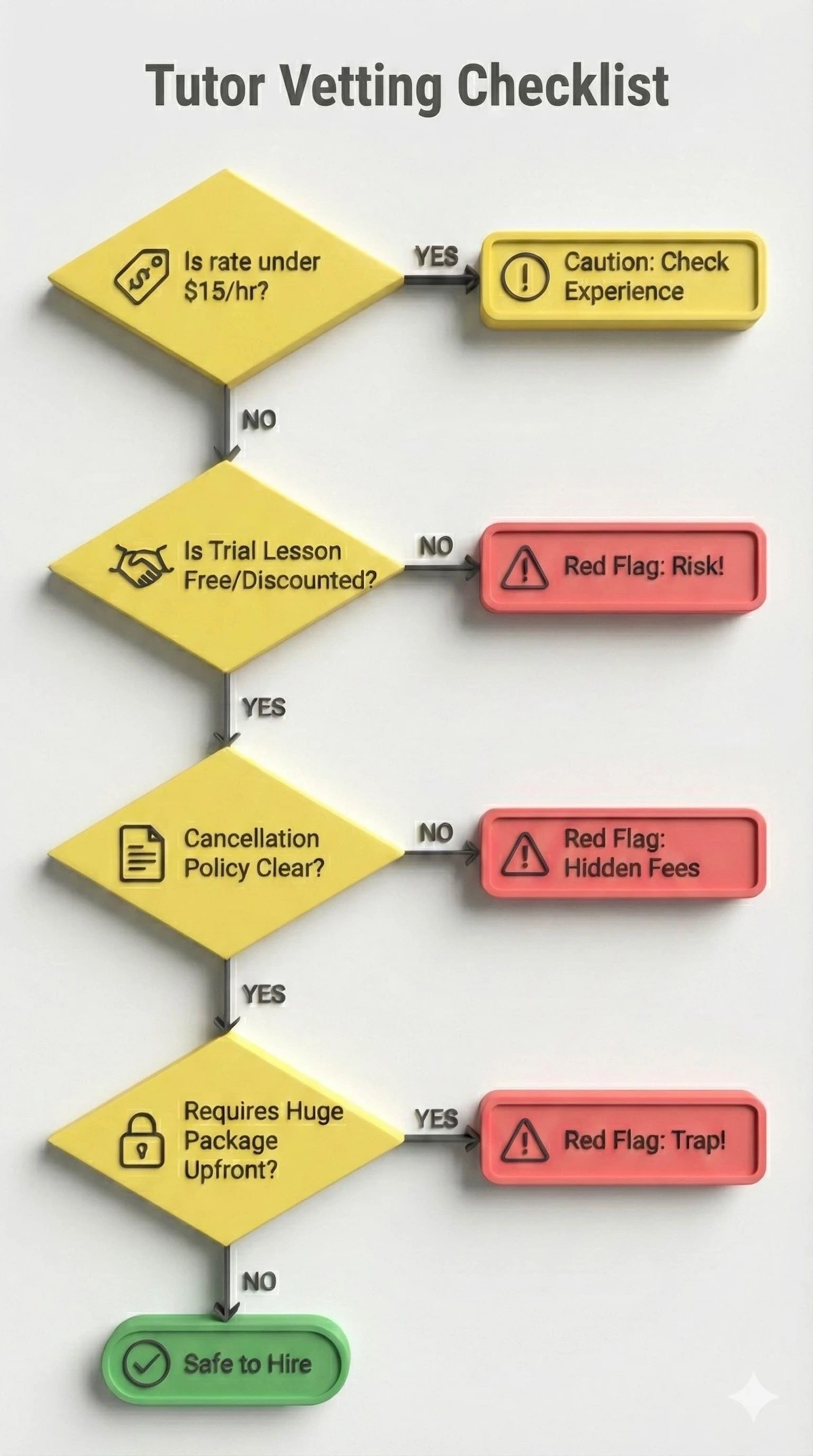
- No trial session and a mandatory 10+ hour package upfront: Any legitimate tutor or agency should offer at least one single session or a discounted trial before locking you into a multi-session purchase. Refusing this is a financial risk signal, not a confidence signal.
- Rates well below the regional floor without explanation: A $10/hr physics tutor in the US is either unqualified, using the low rate as a loss-leader for upselling, or operating on a platform where reviews are unverified. Below-floor rates warrant explicit questions about credential verification.
- No written cancellation policy: Verbal assurances about cancellations are unenforceable. Any arrangement involving more than $100 in prepaid sessions should have written terms. Absence of written terms is a warning sign.
- Guaranteed grade improvements in advertising: Physics tutor effectiveness depends heavily on student effort and input. Any tutor or agency guaranteeing a specific grade improvement is making a claim that no honest tutoring market professional can back up.
- Platform charges both student and tutor commissions: Some platforms take 20–30% from tutors and charge students additional platform fees. This dual-extraction model inflates your effective rate without adding service value. Check platform fee structures before committing.
Frequently Asked Questions About Physics Tutoring Costs
How much does a physics tutor cost per hour in 2026?
In the US, $25–$80/hr covers most physics tutoring situations; AP and university-level specialists charge $80–$160/hr. Online physics tutors globally average $30–$60/hr at the mid-range.
Is online physics tutoring cheaper than in-person physics tutoring?
Yes, online physics tutoring is consistently and significantly cheaper than in-person physics tutoring. Online tutoring eliminates travel fees and allows access to tutors outside your local market, which typically reduces mid-range rates by 30–60%.
Are physics tutors more expensive than math tutors?
Yes, physics tutors are more expensive than math tutors in most markets. Physics commands a 15–30% premium over comparable math tutoring, reflecting the subject’s combined mathematical and conceptual demands and the smaller pool of qualified tutors.
Can you negotiate physics tutor rates?
Yes, physics tutor rates are negotiable — especially for multi-session commitments, off-peak scheduling, and clearly scoped problem areas. Volume commitments of 10+ hours are the most reliable leverage point.
What hidden fees should I watch for when hiring a physics tutor?
Cancellation penalties, package minimums, travel fees, materials charges, platform onboarding fees, and trial session pricing are the six categories most likely to increase your total physics tutoring cost above the advertised hourly rate.
Your Next Step
If you have your regional benchmark, your format preference, and a list of questions for prospective tutors, you have everything you need to evaluate a physics tutor quote with precision. The next decision is whether to start with a free resource to confirm your specific gap, or to move directly to a paid session with a tutor whose background matches your exact need.
If you’re ready to find a qualified physics tutor, MEB connects you with subject-specific tutors matched to your level and timeline — no long-term package required for your first session.
Disclaimer: All rates and fee ranges in this guide are based on 2026 market data from publicly available tutoring platforms, regional price surveys, and verified industry sources. Actual rates vary by tutor, platform, location, and session structure. Verify all pricing directly with your chosen tutor or platform before committing.
Related Reading
******************************
This article provides general educational guidance only. It is NOT official exam policy, professional academic advice, or guaranteed results. Always verify information with your school, official exam boards (College Board, Cambridge, IB), or qualified professionals before making decisions. Read Full Policies & Disclaimer , Contact Us To Report An Error