
The Complete Guide to Statistics Tutoring and Homework Help for High School and College Students

Statistics tutoring offers personalized support to boost understanding and grades. Research shows one-on-one tutoring can improve learning by 3–15 months, meaning targeted help (from homework assistance to tailored lessons) can turn struggles into success.
Why Statistics Is Challenging for Students
Statistics can feel daunting because it combines math reasoning and data analysis, which not all students find intuitive. For example, in the U.S. 64% of fourth-graders and 73% of eighth graders score below proficiency in math, reflecting a general struggle with quantitative subjects. Topics like probability distributions or regression often require strong analytical skills, so many learners fall behind when concepts are introduced too quickly or without enough context.
To understand why this subject feels so different from standard algebra or calculus, it helps to visualize the unique combination of skills required. Statistics sits at the intersection of three distinct cognitive areas:
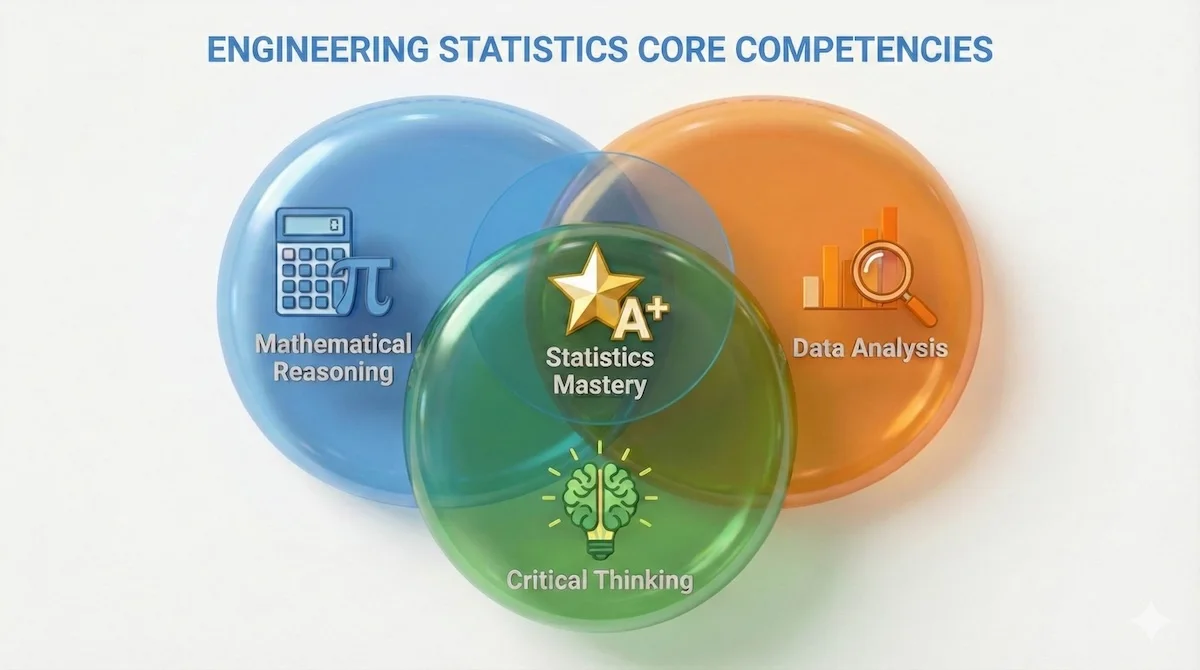
Statistics is challenging because it sits at the intersection of math, analysis, and logic.
As shown above, struggling with just one of these areas—like critical thinking or data analysis—can make the entire subject feel overwhelming.
Benefits of Statistics Tutoring
Working with a statistics tutor provides benefits beyond regular classroom instruction. Tutors can adapt lessons to each student’s pace, offer extra practice, and give immediate feedback on problems. This individualized attention helps students build confidence and proficiency. In fact, targeted tutoring interventions have been shown to yield large improvements: research finds it can raise an average student by 3–15 months of learning.
How exactly does this acceleration happen? Unlike a classroom where errors might go unnoticed for weeks, private tutoring creates a rapid success cycle:
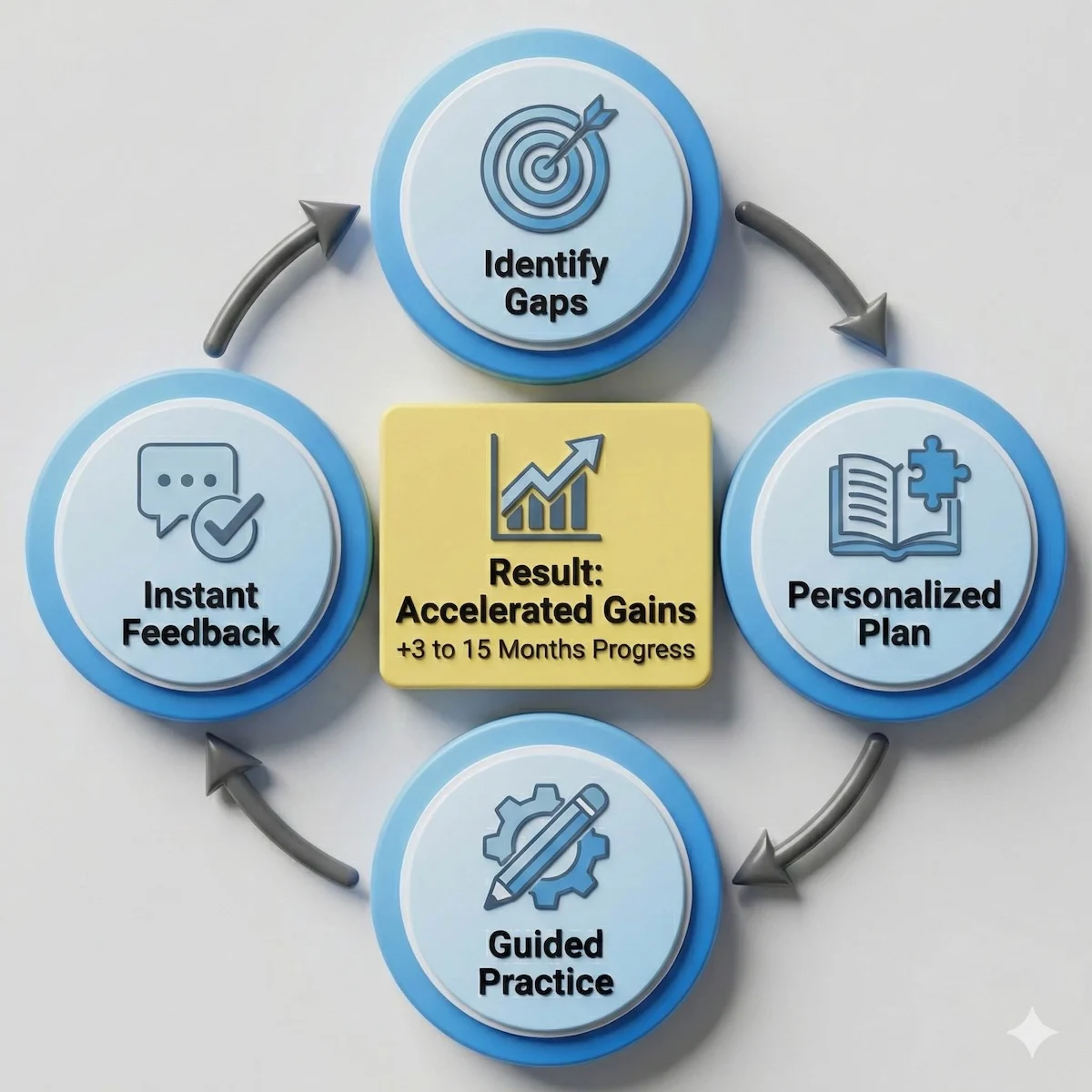
The continuous feedback loop in private tutoring drives faster learning outcomes than traditional study methods.
This continuous loop of immediate feedback and personalized adjustment is the primary driver behind the dramatic learning gains seen in research.
- Personalized learning: Tutors focus on each student’s specific needs. By providing one-on-one attention, a statistics tutor can target problem areas—whether it’s understanding charts, computing probabilities, or solving homework problems—and help students master concepts at their own pace.
- Improved performance: With extra practice and guidance, students often see better grades and test scores. For instance, research shows high-impact tutoring can significantly boost achievement, reflecting gains beyond what standard lessons achieve.
- Homework & assignment help: Tutors assist with specific exercises or projects, ensuring students learn problem-solving strategies. This hands-on support means students get statistics homework help, statistics assignment help and even shorthand requests like “statistics hw help” guided by an expert.
Overall, these benefits explain why many high school and college students turn to tutoring. By addressing knowledge gaps early, students not only raise their grades but also build a stronger foundation for future courses. In other words, investing time with a tutor can make learning statistics much more manageable and rewarding.
Tutors often work with small groups or individual students in a collaborative setting. In such sessions, a tutor can break down complex problems and adapt explanations until the student understands. Studies confirm that this focused instruction yields large learning gains, far beyond what is typically achieved in a standard classroom.
A tutor guiding a student through calculations exemplifies personalized homework help. Working side-by-side on real problems allows the student to immediately apply concepts with guidance. This direct interaction not only clarifies each step but also builds study skills. Research suggests that students who actively engage in tutoring can improve substantially and catch up by as much as half a year or more of learning.
Real Student Success Story
One college sophomore, Emma, struggled with her introductory statistics course. Concepts that seemed clear in earlier math classes suddenly felt confusing, and her test scores were low. Her parents decided to hire a private statistics tutor to help her study regularly. In each weekly session, the tutor reviewed Emma’s homework, answered her questions, and explained concepts in new ways until she understood. Over a few months, Emma’s understanding grew and her confidence soared. She began scoring higher on quizzes, participating more in class, and ended the semester with a solid grade. This story shows how personalized tutoring can transform a student’s experience and results.
Statistics Tutoring Online: Flexibility and Accessibility
Online tutoring has become a popular way to receive help in statistics. An Internet-based statistics tutor online can connect with students from anywhere, which is especially useful for learners in the USA, UK, Gulf countries and beyond. This means students can work with a tutor from home or any location with internet access, making scheduling more convenient. Recent research shows that virtual one-on-one tutoring can be as effective as in-person help: for example, a study found that students who received at least 20 online tutoring sessions saw substantial gains comparable to live tutoring.
Virtual Tools in Statistics Tutoring
Modern online tutoring often uses interactive tools to enhance learning. Tutors might share screens to walk through problem sets, use digital whiteboards to draw graphs, or assign simulations for data analysis. This multimedia approach can make abstract concepts more concrete, and students benefit from features like instant chat and saved session notes. Many students find that having recordings or notes from an online session lets them review tough topics later. In short, online tools help make statistics tutoring more interactive and accessible.
Modern online tutoring is far more than just a video call. It relies on a connected ecosystem of digital tools designed to make data analysis tangible:

Modern online tutoring utilizes advanced digital tools to make abstract statistics concepts concrete and interactive.
By integrating these tools, students don’t just hear about statistics; they actively manipulate data and graphs in real-time alongside their tutor.
Statistics Teaching vs Tutoring
The structural differences between a crowded lecture hall and a private session are significant. Let’s compare the two environments side-by-side:
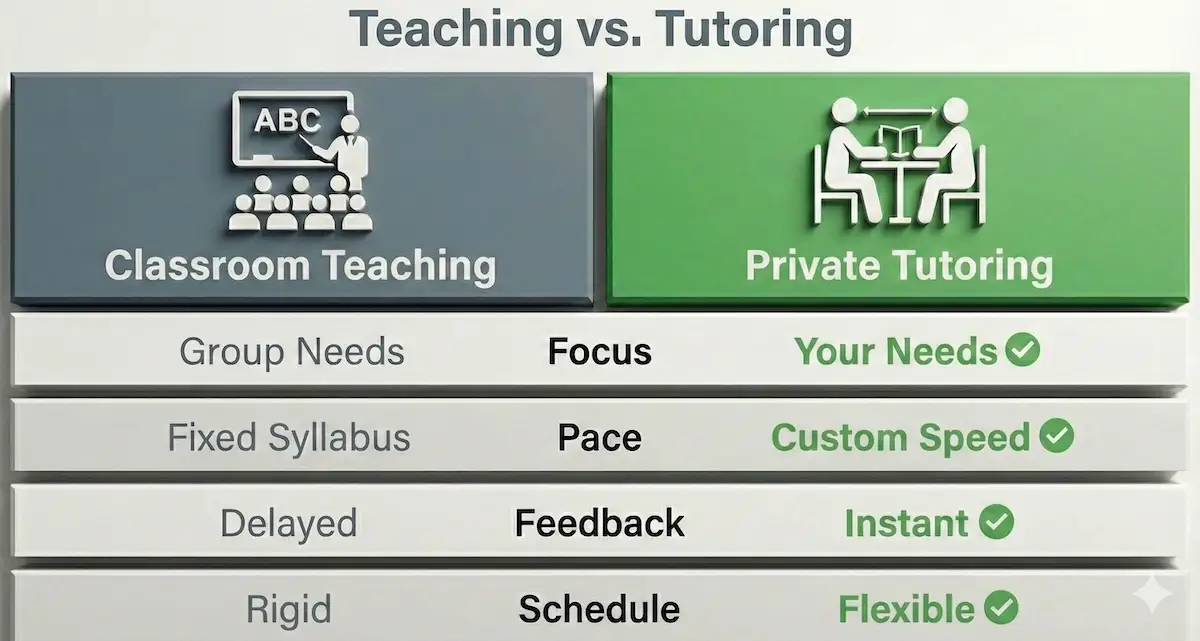
While classroom teaching serves the group, private tutoring adapts entirely to your pace and learning style.
While classroom teaching is designed to cover the curriculum for the group, the table above highlights how tutoring is designed exclusively to close your specific knowledge gaps.
In a classroom setting, statistics teaching typically covers broad lessons to many students at once. A teacher follows a set curriculum and must balance the needs of the whole class, which limits the time available for individual questions. In contrast, a statistics tutor works with one student or a small group and can tailor each session to the learner’s needs. A tutor can pause to ensure understanding, revisit earlier lessons, or skip over material the student already knows. In short, classroom teaching introduces the material, and tutoring reinforces it through personalized practice.
How to Find and Hire a Statistics Tutor
Finding the right mentor doesn’t have to be a guessing game. Use this four-step checklist to ensure you find a qualified tutor who fits your needs:
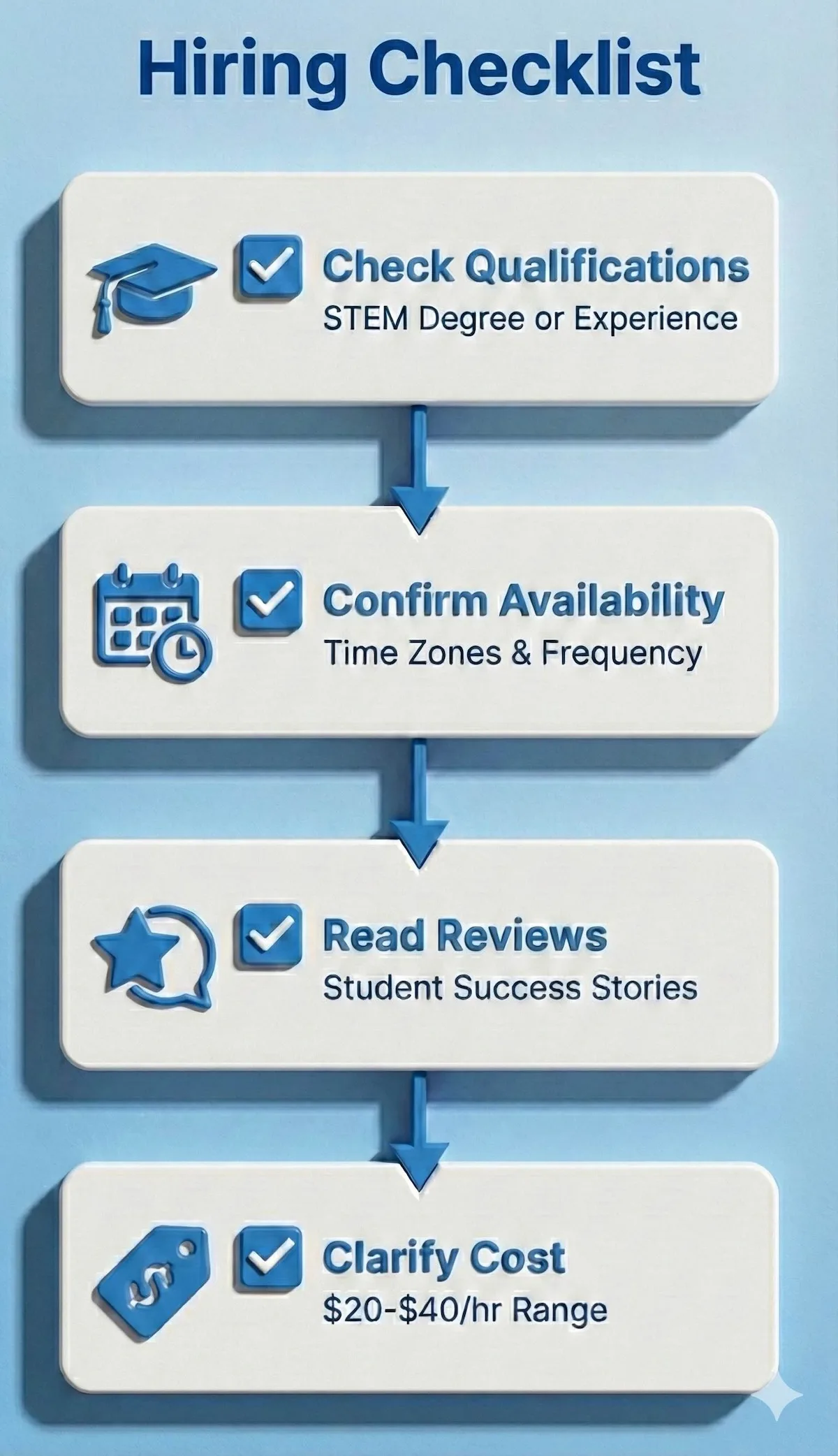
Follow this four-step checklist to ensure you hire the right statistics tutor for your specific needs.
Following these four steps will help you filter out unqualified candidates and find a tutor who can truly deliver the results you need.
Families seeking help often look for a qualified tutor who can cover specific topics like regression analysis or probability distributions. When you hire a statistics tutor, consider the tutor’s background: for example, a degree in math or statistics or experience teaching the subject. Online tutoring platforms, local tutoring centers, and school recommendations can provide lists of available tutors with reviews. Be sure to discuss the tutor’s familiarity with the curriculum (such as AP Statistics, IB, or A-level coursework). Also clarify the pricing: tutors often charge around $20 to $40 per hour depending on their expertise. The goal is to get tailored statistics homework help from someone the student trusts.
Tips for Hiring
- Check qualifications: Look for tutors with strong math or statistics backgrounds, such as a degree in a STEM field or teaching experience in related courses.
- Discuss scheduling: Ensure the tutor’s availability matches the student’s needs, especially if sessions will be online across different time zones.
- Ask for references: Previous students or parents can share how effective the tutor’s teaching was, giving insight into the tutor’s style and impact.
- Clarify costs: Understand hourly rates (the $20–$40 range is common for statistics tutoring) and whether the tutor offers package rates or discounts for regular sessions.
Conclusion
Effective statistics tutoring can make a challenging subject much more approachable for students. By providing one-on-one guidance with data analysis, probability, and other topics, tutors help learners bridge gaps that might remain after class. The evidence shows that consistent tutoring can lead to significant improvements—often helping students catch up by as much as half a year to a full year’s worth of learning. With the right tutor’s support, students gain not only better grades but also the confidence and analytical skills that will last beyond the classroom.
FAQs
Q: What can a statistics tutor help with? A: A statistics tutor can explain difficult concepts and work through problems step-by-step, providing personalized practice so students understand the material and improve their grades.
Q: Is online statistics tutoring effective? A: Yes, studies show that one-on-one online tutoring can produce gains comparable to in-person tutoring when students attend regularly
Q: How is a statistics tutor different from a teacher? A: A statistics teacher leads a full class of students and follows a curriculum, whereas a tutor works individually or in small groups to focus on a student’s specific needs outside class time.
Q: Can a tutor help with homework and assignments? A: Absolutely, tutors often provide statistics homework help and statistics assignment help by guiding students through problems step-by-step.
Q: Who can benefit from statistics tutoring? A: Any student who finds statistics challenging—whether in high school AP classes or college courses—can benefit from extra tutoring support.
Q: How do I hire a statistics tutor? A: Look for experienced tutors (often listed online or through educational services), check reviews, and compare rates (around $20–$40 per hour) to find someone who fits the student’s needs.
Related Subjects:
Actuarial Science
Advanced Statistics
ANOVA
Applied Statistics
Bayesian Statistics
Biostatistics
Business Statistics
Computational Statistics
Data Science
Data visualisation
Decision Theory
Descriptive Statistics
Engineering Statistics
Epidemiology
Excel
Forecasting
HESI
Hypothesis Testing
Inferential Statistics
Information Theory
Linear Regression
Logistic Regression
Mathematical Statistics
MATLAB
Minitab
Monte Carlo Simulation
Multivariate Statistics
Operations Research
Predictive Modeling
Probability Distribution
Psychological Statistics
R Programming
Regression Analysis
Research Methodology
Spatial Statistics
SPSS
Statistical software
Stratified Sampling
Survey Sampling
Systematic Review
Time Series Analysis
Value at Risk (VaR)
******************************
This article provides general educational guidance only. It is NOT official exam policy, professional academic advice, or guaranteed results. Always verify information with your school, official exam boards (College Board, Cambridge, IB), or qualified professionals before making decisions. Read Full Policies & Disclaimer , Contact Us To Report An Error