10 Online Tutoring Websites Ranked Worldwide: Why Bigger Platforms Lose for Engineering

- Specialist platforms with subject-specific vetting outperform large general marketplaces for advanced engineering coursework.
- Wyzant adds a 9% service fee at checkout, above the advertised hourly rate.
- Khan Academy is entirely free but offers no live tutoring or real-time problem-solving.
- Kaplan is purpose-built for test prep, not engineering coursework.
- Tutor.com and TutorMe may be free if your university holds an institutional subscription.
Most students searching for online tutoring land on Wyzant, Chegg, or Tutor.com because those names appear first. That is a reasonable starting point, but it is not a complete picture. A general platform listing 40,000 tutors across 300 subjects solves a different problem than the one an engineering student in their third year of fluid mechanics actually has.
This review compares 10 online tutoring websites worldwide ranked for subject depth, tutor vetting, pricing transparency, and fit for engineering and STEM coursework. If you are also preparing for a rigorous curriculum exam, a qualified AP Seminar tutor can provide the specialist depth that general platforms often lack. A pricing table and a head-to-head alternatives table are included so you can make a direct comparison before committing to any platform.
Check Out: Get Personalized Online Tutoring
How These 10 Platforms Were Evaluated
Each platform was assessed on five criteria: tutor vetting process, subject depth in engineering and STEM, pricing transparency (including fees not shown on the headline rate), session flexibility, and geographic availability for students in North America, the UK, the EU, the Middle East, and Australia.
Platforms were not ranked by marketing reach or number of registered tutors. A platform with 40,000 tutors who self-select their subjects scores lower on vetting than a platform with 200 tutors who passed a subject-specific assessment. Size is not a quality signal.

The Ultimate Guide to Online Tutoring 2026: Expert Tips, Pricing & Platform Reviews
Pricing Comparison: Top 10 Online Tutoring Websites Worldwide
Headline rates are what platforms advertise. Effective rates are what you pay after service fees, subscription minimums, and session minimums are applied. The table below shows both for each platform.
| Platform | Advertised Rate | Effective Rate / Notes | Free Tier? | Engineering Depth |
|---|---|---|---|---|
| My Engineering Buddy (MEB) | Contact for quote | Fixed, transparent; no hidden service fee | Free consult | Very High — engineering specialist |
| Wyzant | $40–$100+/hr | +9% service fee added at checkout | First lesson guarantee | Variable — self-declared subjects |
| Tutor.com | From ~$39/month (subscription) | Per-minute billing after subscription minutes run out | Free via some universities | Moderate — broad STEM coverage |
| Preply | $15–$80+/hr | Platform commission built in; first session refund available | No | Low — primarily languages |
| Skooli | ~$0.82/min (~$49/hr) | Pay-as-you-go; tutors require professional credentials | No | Moderate — K–12 through early college |
| Varsity Tutors | $80–$200+/hr | Premium pricing; packages available; tutors vetted | Free diagnostic tests | High — advanced STEM available |
| TutorMe | Institution-based access | Often free via university subscription; not available to all students | If your institution subscribes | Moderate — depends on tutor pool |
| Chegg | ~$15.95–$19.95/month | Textbook solutions access; live tutoring sold separately | Trial only | Moderate — strong textbook solution database |
| Khan Academy | Free | Entirely free; no live tutoring | Yes — fully free | Low — foundational only |
| Kaplan | $449–$1,699+ (course-based) | Test prep focus; GRE/GMAT/MCAT; not for engineering coursework | Free practice materials | Low — test prep only |
Rates sourced from platform public pages as of 2026. Subscription pricing may vary by plan and region. Always confirm effective cost including any service fees before booking.
1. Wyzant
Wyzant connects students with independent tutors across hundreds of subjects and operates a marketplace model where tutors set their own rates. The critical detail that students who have already tried a general platform and ended up with someone who could not work through their problem set need to understand is this: tutors on Wyzant self-declare their subject areas. There is no subject-specific vetting test for an engineering tutor to demonstrate they can solve a second-order ODE or draw a proper shear-force diagram.
The 9% service fee is added at checkout rather than in the advertised rate. On a $60/hr session that becomes $65.40 before any cancellation terms apply. Wyzant does offer a first-lesson guarantee, which provides some protection if the initial session does not meet expectations.
Best for: Students in general subjects who need flexible scheduling and a large tutor pool to choose from.
Engineering fit: Variable. Filter carefully by credentials, not just subject tags. Request a tutor’s academic background in your specific discipline before booking.
2. My Engineering Buddy
My Engineering Buddy (MEB) is an engineering and STEM specialist platform that has served undergraduate and postgraduate students since 2008. Unlike general marketplaces, MEB tutors are assessed for subject-specific competence in the engineering disciplines they cover — including thermodynamics, structural analysis, control systems, signals and systems, fluid mechanics, and over 2,800 individual subject areas.
Students who consistently find that a general platform’s tutor can explain the concept but cannot execute the derivation are the core audience MEB is built for. Sessions are available via WhatsApp (+91 8971 383660) or email ([email protected]) — no registration wall required — and pricing is quoted directly with no service fee added after the fact.
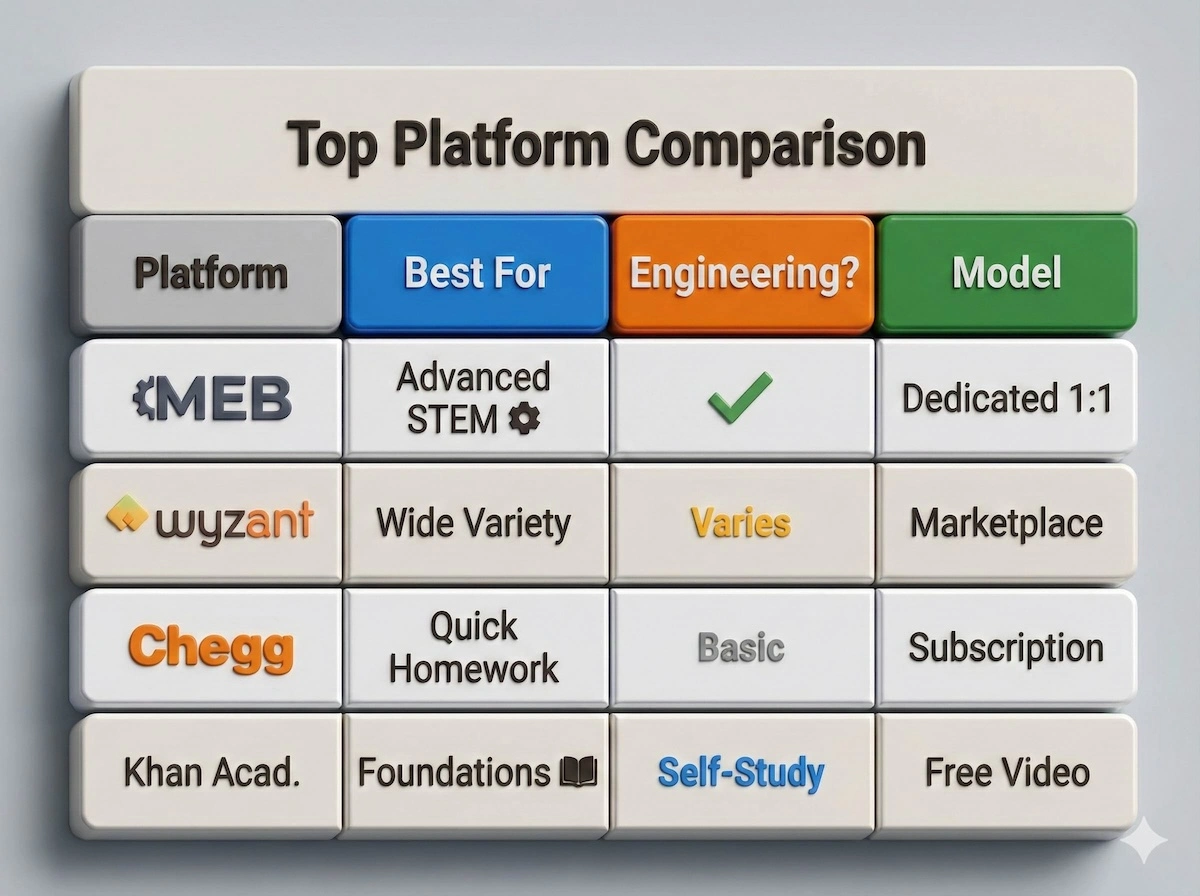
Best for: Engineering students at undergraduate and postgraduate level who need verified subject-depth help, not just concept explanation.
Engineering fit: Very high. Specialist-only platform. If you are facing a statics, dynamics, circuit analysis, or numerical methods problem, this is the most reliably matched option.
Explore the engineering tutoring resources available through MEB to see the full subject list before reaching out.
3. Tutor.com
Tutor.com offers on-demand tutoring with a subscription model and covers a broad range of subjects from K–12 through introductory college courses. One significant advantage is that many universities in North America provide free Tutor.com access to enrolled students — check with your institution before paying for any plan.
For engineering students in years one and two working on calculus, introductory physics, or chemistry prerequisites, Tutor.com sessions can provide useful on-demand support. At advanced coursework levels, however, the platform’s broad coverage model means tutor availability for specific upper-division engineering topics can be inconsistent.
Best for: First and second-year students needing support on prerequisite courses, especially when university access is available at no additional cost.
Engineering fit: Moderate. Reliable for foundational STEM; inconsistent for advanced engineering disciplines.
Students preparing for high-stakes mathematics exams alongside their coursework may also benefit from working with an A-Level Mathematics tutor to consolidate the foundational skills that underpin engineering study.
How Online Tutoring Enhances Test Prep for Standardized Exams
4. Preply
Preply is primarily a language learning platform, and the tutor marketplace reflects that focus. The platform has expanded into other academic subjects, but the depth of subject-specific tutor vetting for engineering is limited compared to STEM-dedicated platforms.
Pricing ranges from $15 to $80+ per hour depending on the tutor, with a first-session refund policy if the match does not work. For students needing support in business English, academic writing, or language preparation for study abroad, Preply is a well-designed option. For engineering coursework, it is the weakest fit of the platforms reviewed here.
Best for: Language learners and students preparing for English-medium academic programmes.
Engineering fit: Low. Not designed for technical STEM subjects at university level.
For a detailed look at one language-focused tutoring provider, the Swoosh English review covering alternatives, pricing, and offerings is worth reading before committing to a language platform.
5. Skooli Inc
Skooli differentiates itself by requiring all tutors to hold professional certifications or a college degree in the subjects they teach. This is a higher bar than most general marketplace platforms. Sessions are on-demand, billed at approximately $0.82 per minute, and the platform includes a virtual whiteboard that supports the kind of step-by-step working that engineering problems require.
Coverage is strongest for K–12 mathematics and science through to first and second-year college coursework. The tutor pool is smaller than Wyzant or Tutor.com, which means availability for advanced upper-division engineering topics may be limited depending on time zone and subject. Note: Skooli’s site returned a connection error during link verification for this article — confirm the URL directly before booking.
Best for: Students who value verified credentials and need on-demand, pay-as-you-go access without a subscription commitment.
Engineering fit: Moderate. Strong through early college; less reliable for advanced engineering topics.
6. Varsity Tutors
Varsity Tutors operates at the premium end of the market, with rates that typically range from $80 to $200+ per hour. Tutors go through a structured vetting process that includes background checks and subject assessments, which sets the platform above pure marketplace models. The platform also offers structured learning plans, progress tracking, and group class formats alongside one-on-one sessions.
For engineering students whose university timeline allows for advance planning — not the student searching at 11pm the night before an exam — Varsity Tutors can provide sustained, structured support across advanced STEM subjects. The cost is the primary barrier, and the platform works best as a semester-long resource rather than an on-demand emergency tool.
Best for: Students with the budget and timeline to engage a vetted tutor for structured, ongoing engineering support.
Engineering fit: High. Vetted tutor pool with genuine subject assessments; expensive relative to other options.
Students who also need support with advanced mathematics programmes will find that working with an IB Math HL/SL tutor alongside a platform like Varsity Tutors can address both curriculum and coursework demands simultaneously.
7. TutorMe
TutorMe is primarily accessed through institutional subscriptions rather than individual student purchases. Many universities and community colleges in North America license TutorMe to provide on-demand tutoring as part of student services — if your institution offers this, it is effectively free to you.
The platform covers STEM subjects and can connect students with tutors within minutes. Quality depends substantially on tutor availability at the time of your session request, and the institutional model means individual students cannot browse or pre-select a preferred tutor across sessions. Note: TutorMe’s site returned a connection error during link verification — check with your institution’s academic support office for the correct access link.
Best for: Students at institutions that license TutorMe, particularly for on-demand help with homework and problem sets.
Engineering fit: Moderate. Subject coverage depends on the tutor pool available at your institution’s subscription tier.
For a broader look at how specialist tutoring services compare to institutional platforms, the Math Make Smart Ltd review covering alternatives, pricing, and offerings provides a useful point of comparison for mathematics-focused support.
8. Chegg
Chegg is most widely used for its textbook solutions database rather than as a live tutoring platform. A Chegg subscription — priced at approximately $15.95 to $19.95 per month — gives access to step-by-step textbook solutions across major engineering textbooks. That is a meaningfully different value proposition from session-based tutoring: it is useful when you need to check your working or understand how a standard problem is solved, but it does not replace a tutor who can work through a novel problem with you in real time.
Students who already have the worked solution but do not understand the method will find Chegg’s solution explanations useful as a starting point. For active problem-solving support, the live tutoring feature is available at an additional cost and operates on a different booking model from the subscription.
Best for: Students who need access to textbook solutions and worked examples across engineering curricula at low monthly cost.
Engineering fit: Moderate for self-directed study. Limited for live interactive problem-solving sessions.
9. Khan Academy
Khan Academy is the strongest free resource in this comparison and should be in every engineering student’s toolkit for foundational mathematics, physics, and early engineering concepts. The platform covers calculus, differential equations, linear algebra, and introductory physics in structured video and practice problem formats. Everything is free.
Khan Academy does not offer live tutoring. It cannot work through your specific assignment or answer a question about why your free body diagram gives a different answer to the one in your textbook. It is a content library, not a tutoring service. Students who confuse these two categories will use Khan Academy as a substitute for tutoring and discover the gap when a deadline arrives and they still cannot solve the problem independently.
Best for: Building foundational understanding of calculus, linear algebra, and introductory physics — particularly in year one of an engineering programme.
Engineering fit: Low for coursework-specific help. Essential as a supplement to any paid platform on this list.
Students who need support with business and management modules alongside their engineering degree may also benefit from working with a managerial accounting tutor to handle the quantitative coursework that often accompanies engineering management programmes.
10. Kaplan
Kaplan is a test preparation company first, and that shapes everything about what it offers. Kaplan’s programmes are structured around GRE, GMAT, MCAT, LSAT, and standardised test preparation, with course prices ranging from $449 to $1,699 or more depending on programme and coaching level. For engineering students considering graduate school who need GRE preparation, Kaplan is a well-structured, evidence-backed option.
For engineering coursework — a signals and systems problem set, a finite element analysis assignment, or a thermodynamics exam — Kaplan is not the right tool. Its tutors are trained in test strategy, not technical engineering derivations. Choosing Kaplan for coursework support is the equivalent of choosing Khan Academy for live session help: structurally mismatched to the actual need.
Best for: Engineering students preparing for the GRE or other standardised graduate admissions tests.
Engineering fit: Low for coursework. High for test preparation specifically.
Engineering students who also need to strengthen their marketing or business elective coursework can find specialist support through a marketing tutor to complement their technical studies.
Bonus: Suited Tutor
Suited Tutor uses an AI-driven matching system to connect students with tutors based on learning style, subject requirements, and scheduling availability. The platform is smaller than the major names in this comparison but positions itself at the intersection of personalised matching and academic support across subjects.
For engineering students, Suited Tutor may be worth exploring if the matching algorithm surfaces a tutor with verifiable depth in your specific discipline. Confirm the tutor’s credentials in the same way you would on any marketplace platform — the match algorithm improves the probability but does not guarantee engineering-specific competence independently of the tutor’s background.
Best for: Students who prefer a matching-first approach and want the algorithm to filter for learning style compatibility alongside subject knowledge.
Engineering fit: Variable. Depends on the matched tutor’s specific background.
For a review of another specialist tutoring provider in a comparable niche, the Medichut tutoring services review and pricing breakdown offers a useful comparison of how specialist platforms structure their offerings.
Also Read: 24/7 Premium 1:1 Tutoring For Standardized Tests
Platform Alternatives at a Glance
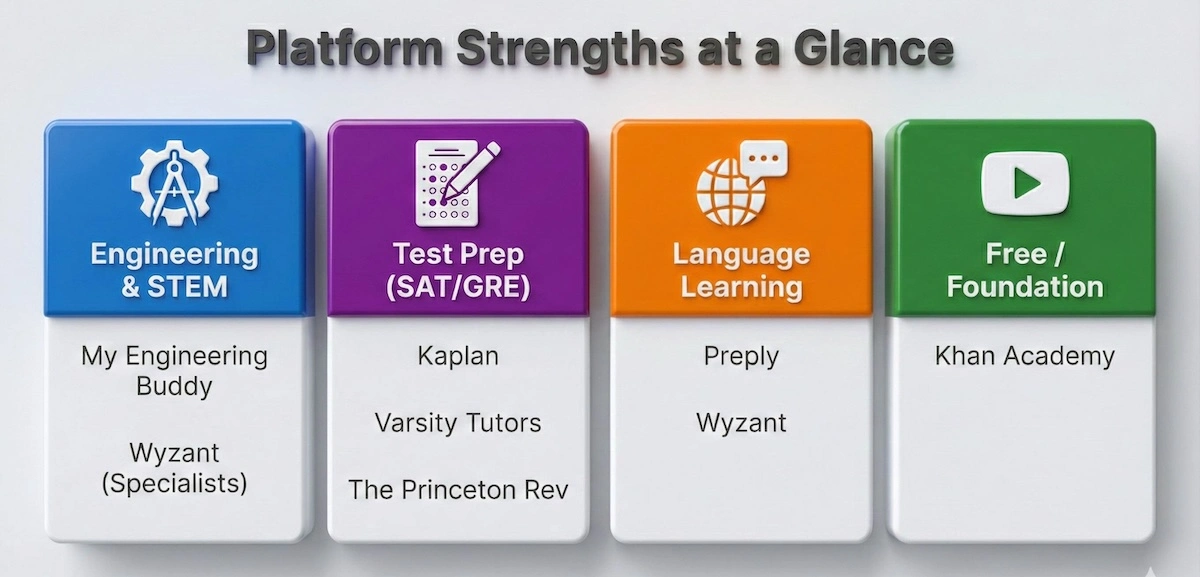
The table below maps each platform to its primary use case, so you can identify which alternative to consider when a platform does not fit your specific need.
| If You Need… | Best Fit | Strong Alternative | Avoid for This Need |
|---|---|---|---|
| Advanced engineering coursework (thermodynamics, structures, circuits) | My Engineering Buddy | Varsity Tutors | Preply, Kaplan, Khan Academy |
| First and second-year STEM prerequisite subjects | Tutor.com (if free via university) or Khan Academy | Skooli, Wyzant | Kaplan, Preply |
| Textbook solution walkthrough and self-study | Chegg | Khan Academy | Kaplan, Preply |
| GRE / GMAT / standardised test preparation | Kaplan | Varsity Tutors | Skooli, TutorMe, Chegg |
| Language learning (ESL, French, Mandarin, Spanish) | Preply | Wyzant | MEB, Kaplan, Skooli |
| Free conceptual review and practice problems | Khan Academy | Chegg (subscription) | Kaplan, Varsity Tutors |
| On-demand tutoring at no cost (if eligible) | TutorMe (via institution) | Tutor.com (via institution) | Varsity Tutors, Kaplan |
| Flexible marketplace with large tutor pool | Wyzant | Preply | TutorMe, Kaplan |
How to Choose the Right Platform for Your Engineering Course
The decision comes down to three questions. First: what is the specific course level? A first-year calculus student and a third-year finite element analysis student have genuinely different platform needs. Second: what is the time horizon? If you need help within the next two hours, on-demand platforms (Tutor.com, Skooli, MEB via WhatsApp) are the right category. If you are planning ahead for a semester, a structured provider like Varsity Tutors or an ongoing MEB engagement is more appropriate. Third: what is the vetting standard you need from the tutor?
Students who have already been through the experience of booking a tutor on a general marketplace and receiving someone who could explain the concept but could not execute the specific problem type — or who listed “mechanical engineering” as a subject but had no verifiable background in it — typically arrive at the same conclusion: subject-specific vetting matters more than platform size.
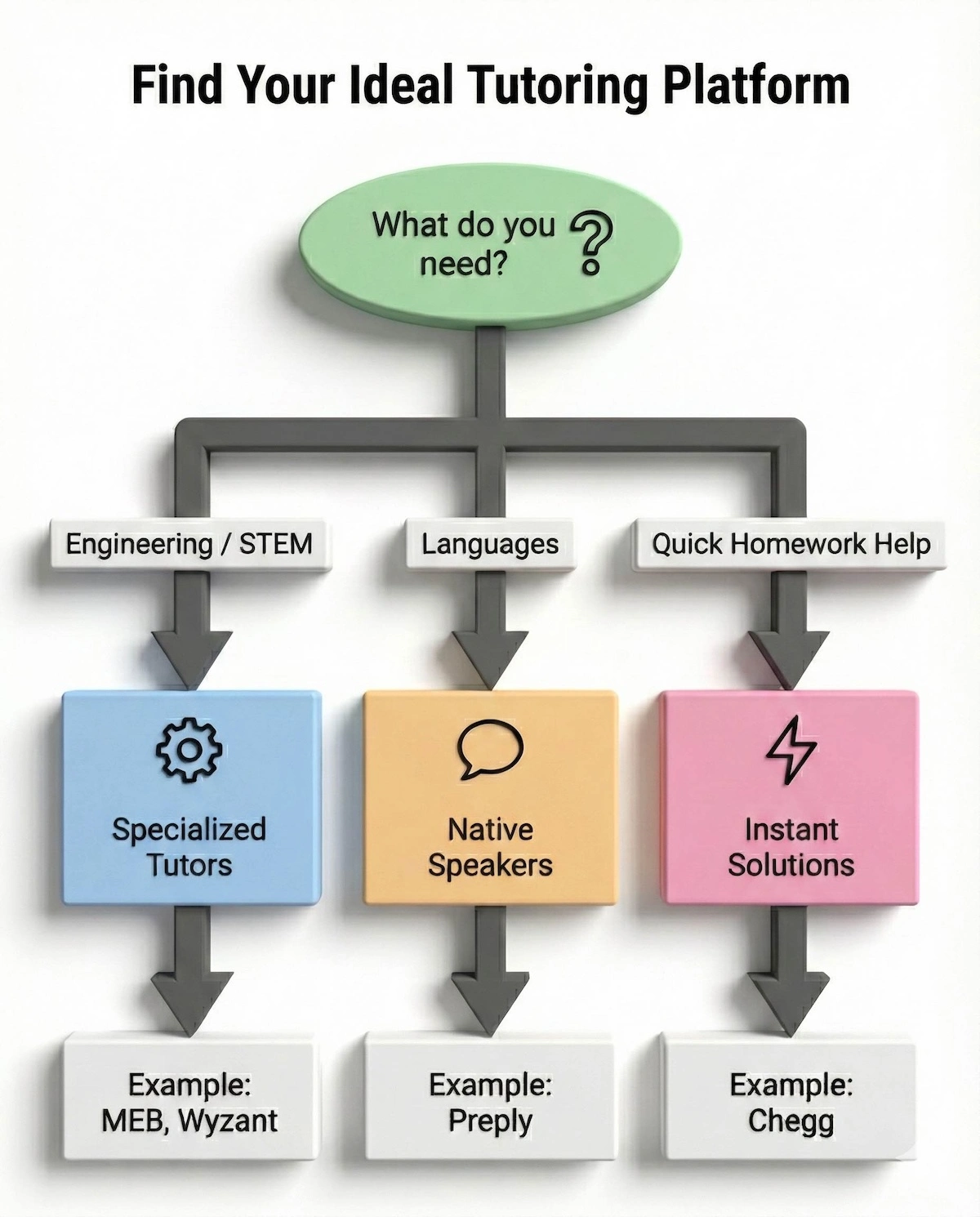
Use the flowchart below to match your situation to the right platform category, then use the pricing table above to check effective cost before committing.
For a deeper look at what to ask before booking any tutor, see the guide to choosing an online engineering tutor on the MEB blog.
For a review of another tutoring provider that focuses on personalised student matching, the Student Helpline review covering alternatives, pricing, and offerings is a useful reference point.
What the Vetting Gap Means for Engineering Students
Tutor vetting is the most consequential differentiator on this list, and it is the one that does not appear in any platform’s headline marketing. On a marketplace model, a tutor lists their subjects. On a vetted model, a tutor demonstrates competence in those subjects before appearing in search results.
The practical consequence for engineering students: on a marketplace platform, the tutor who appears first in a search for “thermodynamics tutor” may have listed thermodynamics as a subject because they took a course in it three years ago. On a specialist platform, that same tutor either passes a subject assessment or is not listed under thermodynamics at all.
Students who consistently get stuck at the same type of problem not because they lack effort, but because the explanations they have received do not address the specific gap in their reasoning are often experiencing the downstream effect of working with a tutor whose subject depth is thinner than their subject label suggests.
The MEB model addresses this directly. Subject coverage at MEB is limited to disciplines where verified tutors are available, which is why the subject list is specific rather than unlimited. See how MEB’s engineering tutoring approach compares to the marketplace model for your specific discipline.
Read More: StudyX Online Tutoring Review: Features, Pricing, and Alternatives
Overall Summary
Across the 10 platforms reviewed, the key split is between general marketplaces, specialist platforms, content libraries, and test prep providers. Each category solves a different problem. Choosing a platform from the wrong category is the most common mistake engineering students make when searching for tutoring help online.
For engineering coursework at intermediate and advanced level, My Engineering Buddy and Varsity Tutors offer the strongest verified tutor depth. For foundational STEM and prerequisite courses, Tutor.com (particularly if your institution provides free access) and Khan Academy are highly effective cost-to-value options. For standardised test preparation, Kaplan is purpose-built and should not be substituted. For language learning, Preply is the clearest fit.
The decision is not which platform is “best” in the abstract. It is which platform is correctly matched to your specific course level, timing need, and required tutor vetting standard.
Ready to connect with a verified engineering tutor? Contact My Engineering Buddy via WhatsApp (+91 8971 383660) or email ([email protected]) — no registration required, and a quote is provided before any session begins.
Frequently Asked Questions
Which online tutoring website is best for engineering students?
My Engineering Buddy is the strongest fit for engineering students at intermediate and advanced levels because it is a specialist platform with subject-specific tutor vetting across more than 2,800 engineering and STEM subjects. Varsity Tutors is the strongest alternative among general platforms for students who need a vetted tutor with demonstrated subject depth.
Is Wyzant good for engineering tutoring?
Wyzant can work for engineering tutoring, but outcomes vary because tutors self-declare their subject areas without a subject-specific vetting test. A 9% service fee is added at checkout above the advertised hourly rate. Students should request verifiable credentials in their specific engineering discipline before booking rather than relying on subject tags alone.
What is the cheapest online tutoring option for engineering students?
Khan Academy is entirely free and covers foundational mathematics and physics relevant to engineering. Tutor.com and TutorMe are available at no cost to students whose universities hold institutional subscriptions. For live, specialist engineering tutoring, My Engineering Buddy provides a direct quote with no hidden service fees, which makes effective cost easier to compare.
Is Chegg tutoring worth it for engineering students?
Chegg’s primary value for engineering students is its textbook solutions database rather than its live tutoring function. A subscription gives access to step-by-step solutions across major engineering textbooks at approximately $15.95 to $19.95 per month. For interactive problem-solving where you need a tutor to work through a novel problem in real time, live session platforms like MEB or Varsity Tutors are more appropriate.
How do I know if an online tutor is qualified in my engineering subject?
Ask directly for the tutor’s academic qualification or professional background in the specific discipline before booking. On marketplace platforms, subject tags are self-declared. On specialist or vetted platforms, tutors have passed subject assessments. For engineering subjects, relevant qualifications include a degree or higher in the specific engineering field, not just a general STEM background.
Are there free online tutoring websites for engineering students?
Khan Academy provides free foundational content in calculus, linear algebra, and introductory physics. TutorMe and Tutor.com are free at the point of use for students at institutions with active subscriptions. For advanced engineering coursework requiring a live specialist tutor, fully free options are not available, but platforms such as MEB provide an upfront quote so you know the cost before any session begins.
Disclaimer: Information in this article is for educational comparison purposes only. Pricing, availability, and platform features change over time. Verify current rates and terms directly with each platform before purchasing any tutoring service.
Related Reading
******************************
This article provides general educational guidance only. It is NOT official exam policy, professional academic advice, or guaranteed results. Always verify information with your school, official exam boards (College Board, Cambridge, IB), or qualified professionals before making decisions. Read Full Policies & Disclaimer , Contact Us To Report An Error