A-Level Physics Explained: Challenges, Skills, and How to Succeed

- A-Level Physics demands deep conceptual understanding and mathematical fluency, not memorization.
- Only 14.5% of students achieved an A* in A-Level Physics in 2023 (Ofqual).
- One-on-one tutoring can boost academic progress by up to five months (Education Endowment Foundation).
- Physics builds analytical thinking, problem-solving, and mathematical fluency valued across many careers.
- Starting tutoring early prevents small knowledge gaps from becoming major obstacles before exams.
 Sarah had always been fascinated by the night sky. She’d spend hours looking through her telescope, dreaming of understanding the forces that governed the stars. When she started A-Level Physics, she was excited. But that excitement soon turned to anxiety. Concepts like quantum superposition and special relativity felt less like science and more like abstract philosophy.The equations on the board seemed to mock her. She wasn’t just struggling; she was starting to lose the very passion that had led her to the subject.
Why A-Level Physics Can Feel Like Climbing a Mountain
Sarah’s story isn’t unique. For many students across the UK, USA, and the Gulf, the jump from GCSE or IGCSE to A-Level Physics is a significant shock. Where GCSE often rewards memorization, A-Level demands deep conceptual understanding and mathematical fluency. Suddenly, concepts aren’t just descriptions; they are expressed through the language of calculus, a tool that many are learning concurrently.This dual challenge — mastering new physics concepts while simultaneously applying advanced mathematics — is a core reason for the subject’s notorious difficulty. If you want to understand how to learn physics more effectively, recognizing this shift in expectations is the essential first step.It helps to visualize exactly where this gap comes from. The table below contrasts the fundamental shifts in expectations between the two levels.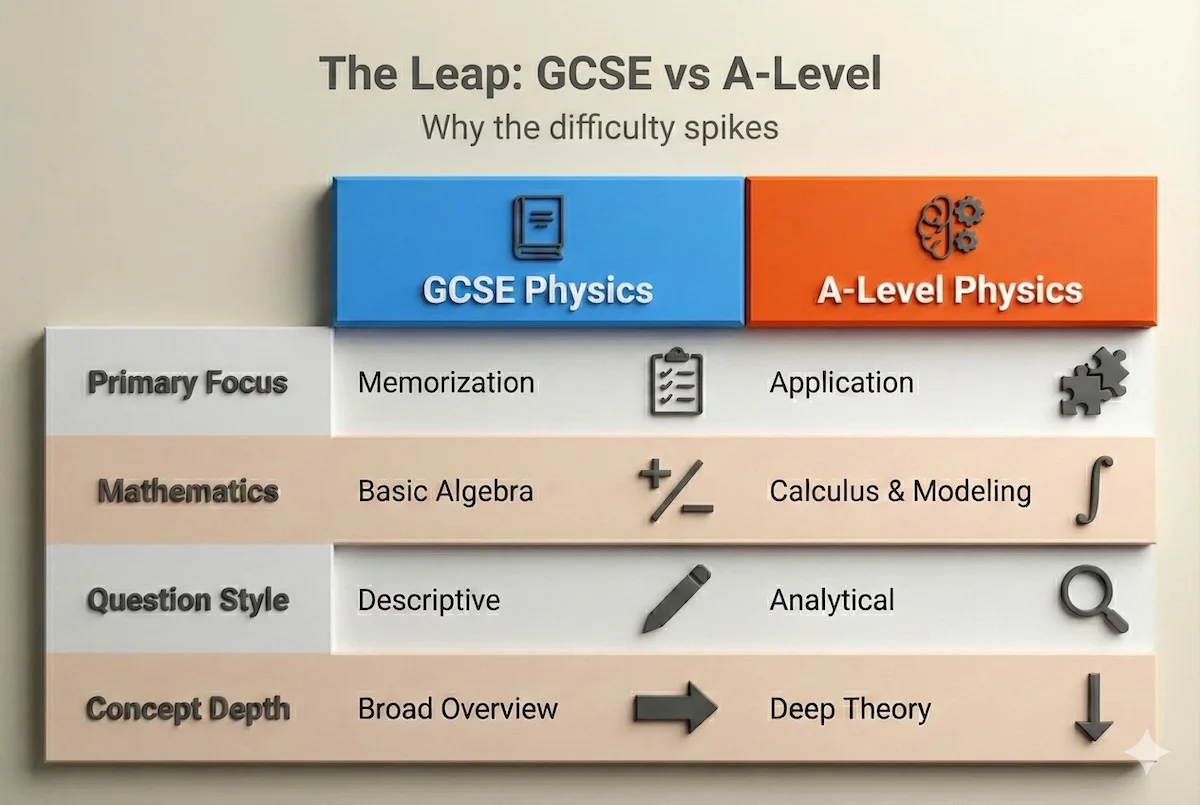
The jump from GCSE to A-Level involves shifting from memorization to deep application and calculus.
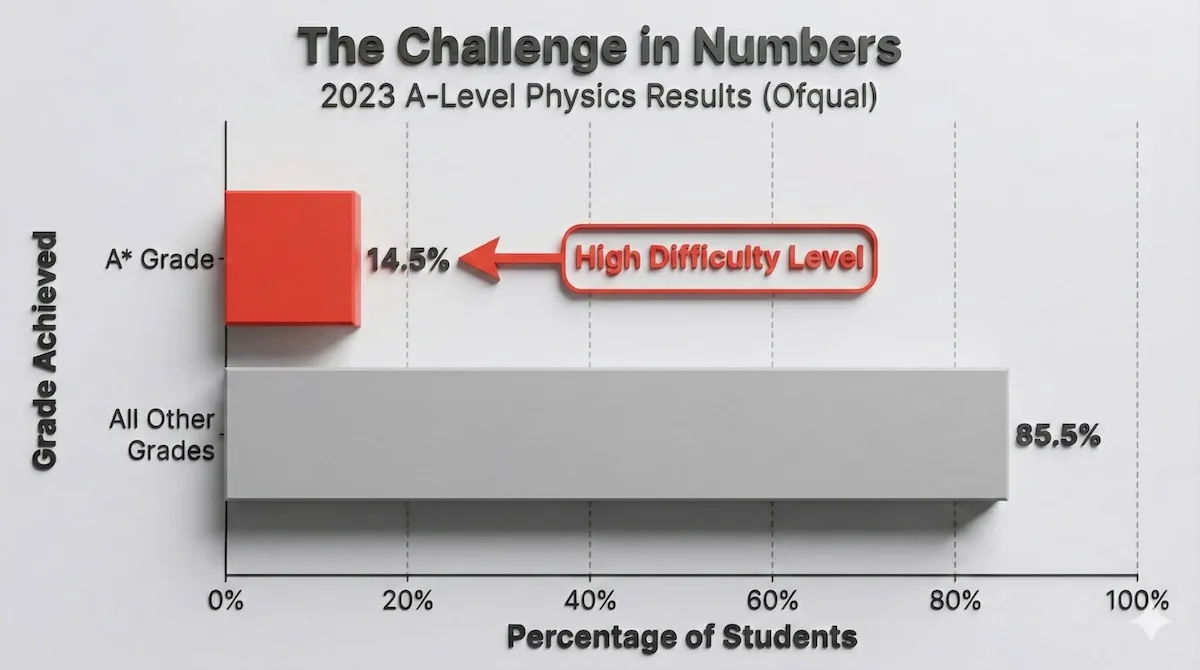
Ofqual data confirms the challenge: only 14.5% of students achieved the top grade in 2023
The Real Goal of A-Level Physics Teaching: Building a Scientist’s Mindset
The ultimate goal of an A-Level Physics curriculum isn’t just to teach facts; it’s to cultivate a scientific mindset. It trains your brain to think critically, to break down complex problems into manageable parts, and to approach challenges with logic and creativity. An excellent A-Level Physics teacher doesn’t just give you the answers; they guide you on the path to finding them yourself.Think of it like learning to play a musical instrument. You can memorize all the scales and chords (the formulas), but that doesn’t make you a musician. To create music, you need to understand theory, practice consistently, and learn how to improvise. A-Level Physics is the same.It’s about learning the “music” of the universe and applying it to compose elegant solutions to complex problems. This analytical skill is precisely why universities and employers value physics qualifications so highly.To understand this transformation, we can visualize the journey from novice to expert using the musician analogy.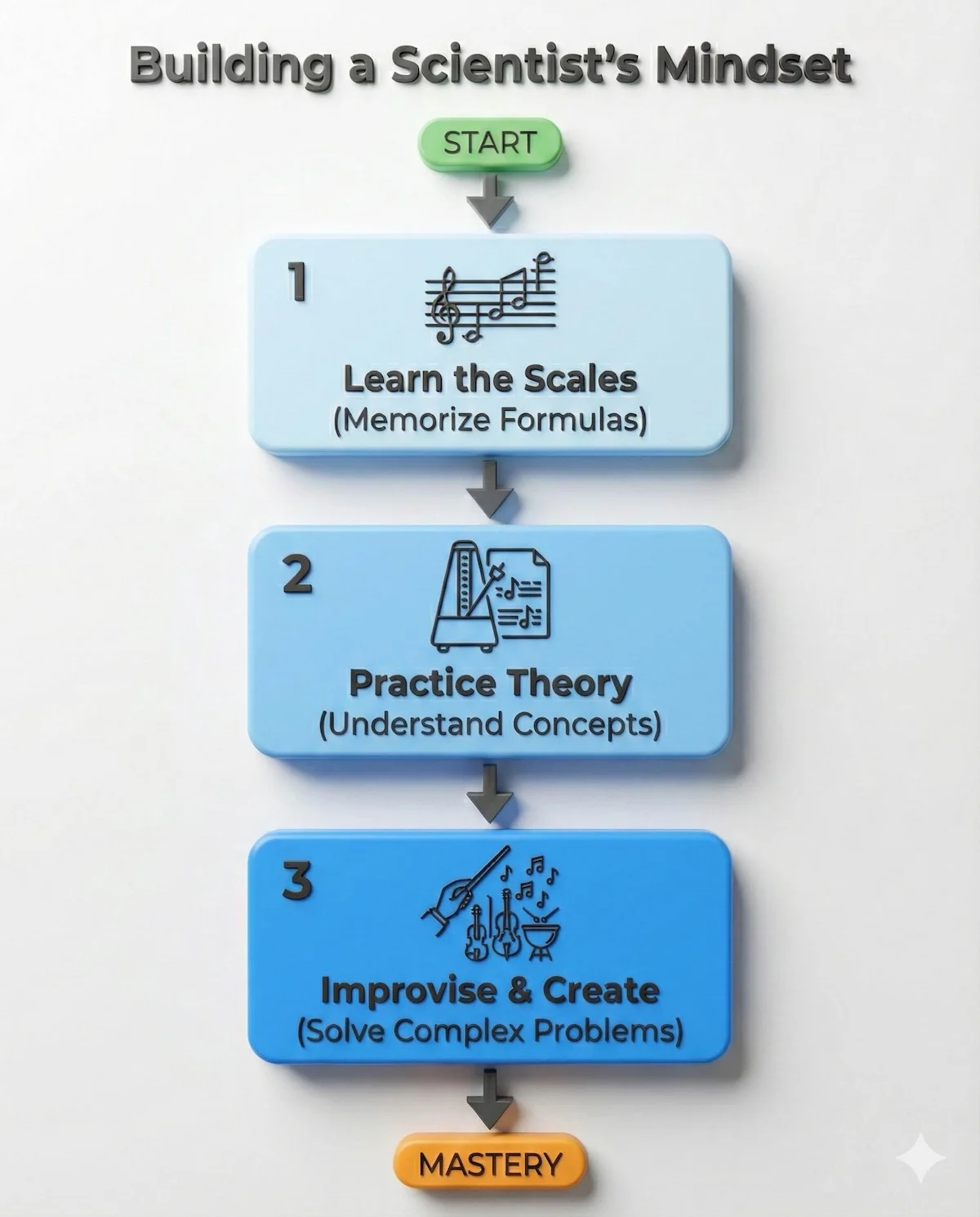
Like learning music, physics requires moving beyond memorizing ‘scales’ to composing your own solutions.
Bridging the Gap: When to Seek Extra Support
Even with great classroom instruction, gaps in understanding can appear and widen quickly. Maybe it’s a specific topic like electromagnetism that just won’t click, or perhaps the pace of the class is too fast to absorb the details of nuclear physics. With class sizes often exceeding 25 students, it’s impossible for a teacher to address every individual question.This is where many students start searching for additional support, hoping for a quick fix. They might turn to online forums or video platforms. While these can be useful, they often present a one-size-fits-all explanation that might not address a student’s specific point of confusion.Imagine struggling with Faraday’s Law of Induction and finding a forum thread where ten different people explain it in ten different ways, some of which are subtly incorrect or apply only to niche cases. This can create more confusion than clarity. What a student truly needs isn’t just an answer; they need a dialogue to understand the why behind the method.Similarly, when working through a larger project, the goal should be to master the concepts for the long term, not just to complete a single task for a grade. Understanding how to solve a physics problem step by step is a skill that pays dividends across every topic in the course.If you are unsure whether your struggles are normal or a sign you need help, use this simple check.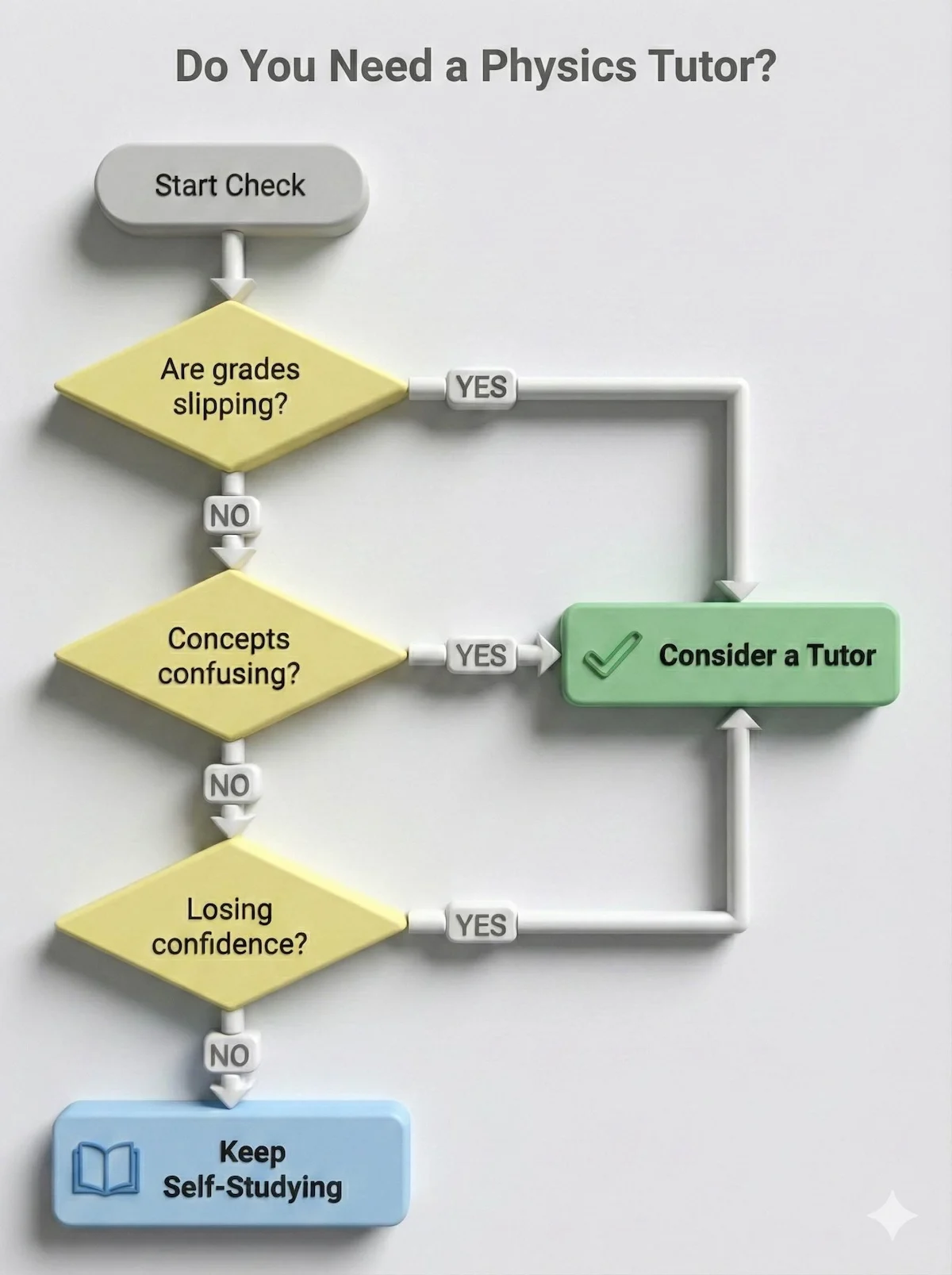
Follow this simple decision path to see if personalized tutoring is the right step for you.
A Personal Guide Through the Cosmos: The Power of One-on-One Tutoring
When generic resources aren’t enough, personalized support can be a genuine game-changer. A private tutor acts as a personal academic guide, tailoring their approach to your specific learning style, identifying your unique strengths, and patiently working through your weaknesses. They can slow down, revisit foundational concepts that might have been shaky from the start, and offer alternative explanations until everything clicks into place.Online A-Level Physics tutoring has made this specialized help more accessible and powerful than ever before. Modern online platforms are not just video calls; they are sophisticated learning environments. They feature interactive digital whiteboards where student and tutor can sketch diagrams and solve equations together in real-time.Sessions can be recorded, allowing students to revisit complex explanations before an exam. This flexibility means a student in Dubai can connect with a top physicist from Cambridge, fitting sessions around their own schedule. Research from the Education Endowment Foundation has shown that this kind of consistent, one-on-one tutoring can boost a student’s academic progress by as much as five months.It transforms learning from a passive reception of information into an active, engaging conversation. For students who want structured guidance on specific topics, exploring resources on mastering physics homework can complement what a tutor covers in sessions. Students preparing for standardized exams may also benefit from working with an AP Physics tutor to build the same depth of conceptual understanding.How to Find the Right A-Level Physics Tutor for You
So, how do you find the right person to guide you on this journey? When you decide to find an A-Level Physics tutor, you’re looking for more than just someone who knows the subject. You’re looking for a guide who can make the subject come alive.Key Qualities of a Great Tutor
- Deep Subject Expertise: They should have a profound understanding of physics that goes far beyond the A-Level textbook. Often, the best tutors have degrees in physics or engineering from top universities.
- Proven Teaching Ability: Knowledge is one thing, but the ability to explain it clearly and patiently is another. A great A-Level Physics tutor can break down the most complex ideas into simple, digestible concepts.
- Adaptability and Patience: They should be able to adapt their teaching style to fit your needs and be patient as you work through difficult problems. Learning isn’t always linear, and a good tutor understands that.
- Passion for Physics: Enthusiasm is contagious. A tutor who is genuinely passionate about physics can reignite a student’s own interest and curiosity in the subject, making learning feel less like a chore and more like an adventure.
More Than an Exam: Skills You Gain from A-Level Physics
The benefits of mastering A-Level Physics extend far beyond achieving a top grade. The process itself builds a powerful and versatile skillset that is in high demand in the 21st-century economy, forming the foundation for some of the world’s most innovative and rewarding careers.The Lifelong Toolkit Physics Provides
- Analytical and Critical Thinking: Physics trains you to deconstruct complex systems, analyze information from first principles, and evaluate evidence with a rigorous, critical eye.
- Advanced Problem-Solving: You learn how to approach unfamiliar, multi-step problems systematically, a skill that is essential in any field from software engineering to strategic management.
- Mathematical Fluency: The subject forces you to become fluent in the language of mathematics, making you comfortable with abstract models, data analysis, and quantitative reasoning.
- Resilience and Perseverance: Grappling with difficult physics problems builds mental toughness. It teaches you the value of persistence, iteration, and intellectual curiosity in the face of a challenge.
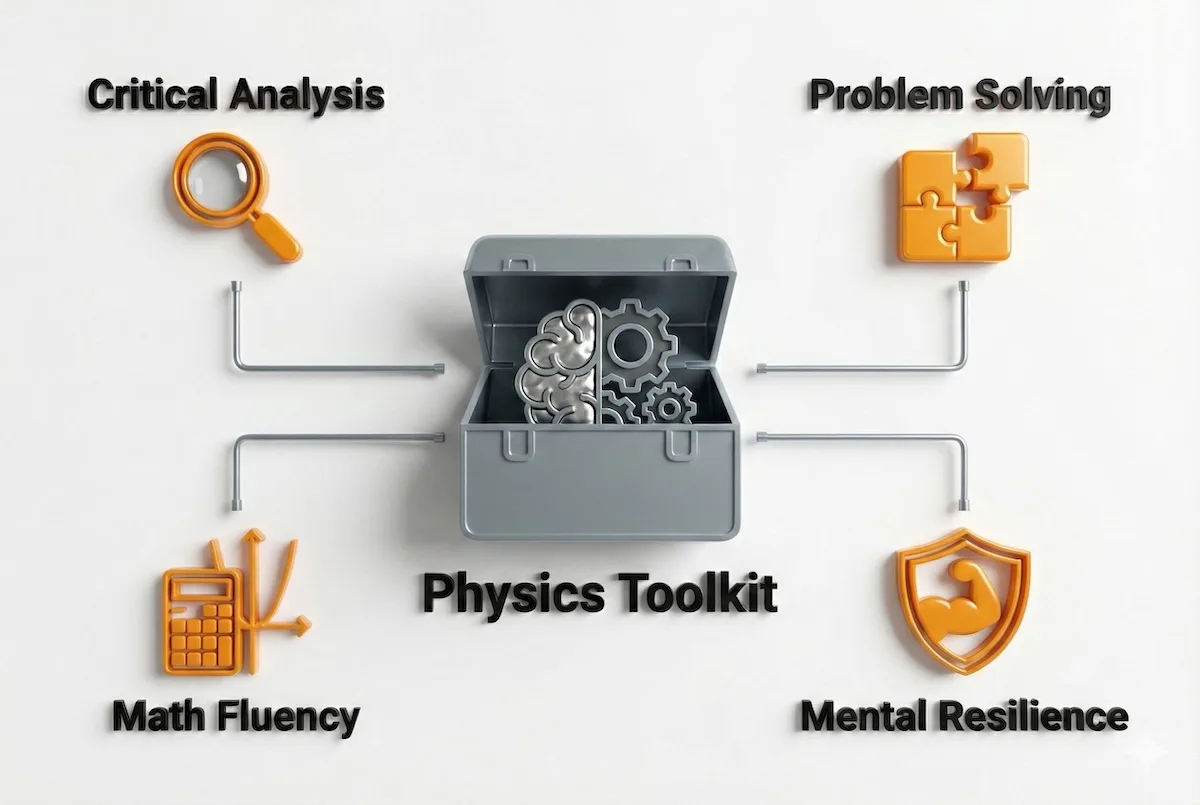
Physics equips you with a versatile toolkit of analytical and resilient thinking skills valued by employers.
Your Journey Into Physics Starts Now
Let’s go back to Sarah. Feeling defeated, she and her parents decided to find an A-Level Physics tutor online. Her tutor, a PhD student from a top university, didn’t just give her answers. He asked questions. He used real-world analogies that made abstract concepts tangible.Slowly but surely, the fog of confusion began to lift. Sarah wasn’t just learning how to pass her exams; she was learning how to think like a physicist. She rediscovered the wonder she felt when looking through her telescope, now armed with the understanding to appreciate the cosmos on a much deeper level.The path through A-Level Physics is undoubtedly challenging. But it’s a challenge that forges incredible skills and opens doors to a universe of opportunities. You don’t have to walk it alone. With the right support and a resilient mindset, you can not only conquer the subject but also unlock a lifelong passion for understanding the world around you.For students curious about the physics behind everyday phenomena, exploring topics like the physics behind flying spiders is a reminder of how far the subject’s reach extends. Those looking to go deeper into AP-level content may also find value in working with an AP Physics 1 tutor to reinforce core mechanics and energy concepts. And if you want to pair your physics studies with a related discipline, connecting with an online chemistry tutor can strengthen your understanding of the quantitative sciences together.Frequently Asked Questions About A-Level Physics
How much does A-Level Physics tutoring usually cost?
Expert A-Level Physics tutoring typically ranges from $20 to $40 per hour, depending on the complexity and the tutor’s qualifications.Is online A-Level Physics tutoring as effective as in-person tutoring?
Yes, for many students, online A-Level Physics tutoring is equally or even more effective due to its convenience and access to a wider pool of experts.When is the best time to hire a tutor for A-Level Physics?
It’s best to start A-Level Physics tutoring as soon as you feel you’re falling behind, rather than waiting until just before exams.Can an A-Level Physics tutor help with a specific exam board such as AQA, OCR, or Edexcel?
A qualified A-Level Physics tutor will be able to tailor their teaching to the specific curriculum and requirements of your exam board.What is the main benefit of one-on-one A-Level Physics tutoring?
The primary benefit of one-on-one A-Level Physics tutoring is personalized attention that is focused entirely on your specific learning needs and pace.How do I know if I really need an A-Level Physics tutor?
If your grades are slipping, you feel constantly confused, or you’re losing confidence in A-Level Physics, a tutor can help.Related Reading
******************************
This article provides general educational guidance only. It is NOT official exam policy, professional academic advice, or guaranteed results. Always verify information with your school, official exam boards (College Board, Cambridge, IB), or qualified professionals before making decisions. Read Full Policies & Disclaimer , Contact Us To Report An Error