
15 Physics Homework Hacks That Actually Work (2026 Guide)

Physics homework defeats students not because the subject is impossible but because most study approaches are wrong for how physics actually works.
Reading notes before attempting problems, re-copying derivations without testing understanding, and using calculators before establishing the correct equation structure are habits that feel productive but produce poor results.
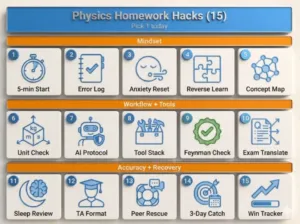
The 15 hacks in this article address the real failure points: unit tracking, diagram-first problem-solving, supervision preparation, and the honest use of digital tools. This updated guide adds subject-specific strategies for mechanics, electromagnetism, and thermodynamics, an honest comparison of AI tools, and guidance on what to do in the 15 minutes before and after every physics session.
Unlocking the Universe: How to Conquer A-Level Physics and Why It’s Worth the Challenge
What Are the Most Effective Physics Homework Hacks for Mechanics Problems?
Mechanics problems fail at one of three points: the free body diagram is missing or wrong, unit conversions are skipped under time pressure, or the student jumps to an equation before identifying which physical principle applies. Each of these is fixable with a specific habit change, not more study time.
Hack 1 Draw the free body diagram before writing any equation.
This is not a suggestion for beginners. It is a non-negotiable step even for experienced students.
Every force acting on every object must be identified, labelled with magnitude and direction, and confirmed against Newton’s third law before the first equation appears.
Students who skip this step and work from memory typically place forces in the wrong direction or omit contact forces, producing errors that are difficult to trace.
Hack 2 Write units at every algebraic step, not just in the final answer.
Dimensional analysis catches errors that numerical checking misses. If your intermediate expression has units of kg·m/s² and you are computing a velocity, you know before reaching the calculator that something has gone wrong.
The habit of writing [kg], [m/s²], [N] alongside every value takes approximately five seconds per line and eliminates an entire category of careless errors.
Hack 3 Identify the conservation principle first.
Before selecting an equation, answer: is energy conserved in this system? Is momentum conserved? Is it a static or dynamic problem? Mechanics problems almost always hinge on one dominant principle.
Students who jump directly to kinematics equations on a collision problem, for example, often apply the wrong framework entirely. A 15-second classification step at the start of each problem prevents this.
Hack 4 Resolve vectors into components systematically, not by intuition.
Choose a coordinate system—positive x to the right, positive y upward is the default write it on the page, and resolve every vector into x and y components explicitly.
Students who try to reason about vector directions in their head produce sign errors at a rate far higher than those who use a consistent written component method.
Hack 5 Check limiting cases for any derived formula.
After deriving or applying a formula, test it at the extremes: what happens as mass ∞, or as angle 0°? If the formula gives a physically nonsensical result at a limiting case, the derivation contains an error.
This technique, borrowed from theoretical physics practice, catches structural mistakes that numerical substitution masks.
| Mechanics error type | Root cause | Hack to apply |
| Wrong force direction | Skipped free body diagram | Hack 1: Draw FBD first, always |
| Unit mismatch in final answer | Units not tracked algebraically | Hack 2: Write units at every step |
| Wrong equation applied | Principle not identified before equations | Hack 3: Classify conservation first |
| Sign error in components | Verbal vector reasoning | Hack 4: Explicit component resolution |
| Formula error undetected | No verification step | Hack 5: Test limiting cases |
Which Physics Homework Strategies Work Best for Electromagnetism?
Electromagnetism has a higher conceptual density than mechanics because the physical phenomena fields, flux, induction are invisible and counterintuitive.
The most effective strategies compensate for this by externalising the spatial reasoning that EM problems demand.
Struggling with Physics? Get online tutoring and homework help from the best Online Physics Tutor
Hack 6 Sketch the field geometry before attempting any calculation.
Electric field lines, magnetic field direction (using the right-hand rule explicitly, not from memory), and the orientation of surfaces relative to fields must all be drawn before equations appear.
Students who approach Gauss’s law or Faraday’s law numerically without first establishing the geometric picture produce answers that may be mathematically consistent but physically incorrect a particularly dangerous error type because it can survive a numerical check.
Hack 7 State the symmetry argument explicitly.
Gauss’s law and Ampère’s law are only tractable when a symmetry exists that makes the field constant over the chosen Gaussian surface or Ampèrian loop.
Before applying either law, write down: “The field is uniform over this surface because [spherical/cylindrical/planar] symmetry implies…” Students who apply the integral form without this step frequently arrive at unsolvable integrals and cannot diagnose why.
Hack 8 Use Lenz’s law as a direction check, not just a rule.
After computing the magnitude of an induced EMF using Faraday’s law, use Lenz’s law independently to confirm the direction: the induced current must oppose the change in flux that created it.
Treating these as two separate checks one for magnitude, one for direction catches sign errors that a single calculation pass misses.
Hack 9 Build a personal reference table for the four Maxwell’s equations.
Write each equation in both integral and differential form, note what physical law it encodes (Gauss’s law for E, Gauss’s law for B, Faraday, Ampère-Maxwell), and annotate which symmetry conditions simplify each one.
This table, built by hand and reviewed before problem sets, encodes the structural relationships that multiple-choice questions and derivation problems test most heavily.
| EM problem type | Most common error | Recommended hack |
| Gauss’s law application | Missing symmetry argument | Hack 7: State symmetry explicitly |
| Faraday’s law (induced EMF) | Correct magnitude, wrong sign | Hack 8: Lenz’s law direction check |
| Ampère’s law | Wrong loop orientation | Hack 6: Sketch field geometry first |
| Maxwell’s equations recall | Confusing integral and differential forms | Hack 9: Personal reference table |
What Are the Best Tactics for Thermodynamics Physics Homework?
Thermodynamics problems punish students who confuse state variables with process-dependent quantities and who apply idealised equations without checking whether the stated conditions justify them. Two habits address almost all thermodynamics errors.
Hack 10 Label every process before applying any equation.
Is this process isothermal (constant T), adiabatic (no heat exchange), isobaric (constant P), or isochoric (constant V)? Write this label at the top of the solution. Each process type has a specific set of simplifications: for an isothermal ideal gas, ΔU = 0 and Q = W; for an adiabatic process, Q = 0.
Students who apply the first law of thermodynamics (ΔU = Q W) without identifying the process type cannot simplify correctly and produce unnecessarily complex expressions.
Hack 11 Draw the P-V diagram for every thermodynamic cycle problem.
The work done by a gas in a cycle equals the area enclosed by the cycle on a P-V diagram. This visual representation makes the sign of work (positive for clockwise cycles in a heat engine, negative for counterclockwise) immediately apparent.
Students who work cycle problems algebraically without the diagram consistently make sign errors on work terms.
Hack 12 Check units and physical reasonableness of entropy changes.
Entropy has units of J/K. An entropy calculation producing a negative value for an irreversible process in an isolated system violates the second law this is an immediate red flag that the calculation contains an error.
Similarly, a Carnot efficiency greater than 1 is unphysical and signals a temperature unit error (mixing Kelvin and Celsius is the most common cause).
| Thermodynamics problem type | Typical error | Applicable hack |
| First law application | Missing process identification | Hack 10: Label the process first |
| Cycle work calculation | Incorrect work sign | Hack 11: Draw P-V diagram always |
| Entropy calculation | Negative result for irreversible process | Hack 12: Physical reasonableness check |
| Carnot efficiency | η > 1 (temperature unit error) | Hack 12: Check units T must be in Kelvin |
Which AI Tools Actually Help With Physics Homework and Which Don’t?
AI tools for physics homework fall into three distinct categories: symbolic computation engines, large language model (LLM) assistants, and step-by-step solver platforms. Each has genuine strengths and specific failure modes that students using them uncritically will not notice.
Wolfram Alpha is the most reliable tool for symbolic computation, unit conversion, and numerical verification.
It handles differential equations, integral evaluation, and dimensional analysis correctly and shows intermediate steps for most standard calculations. Its primary limitation is that it does not explain the physical reasoning behind a problem it computes the answer to what you type, which requires that you already know how to correctly frame the question.
Symbolab is well-suited for algebraic manipulation, calculus steps, and showing worked solutions to standard equation types. It is particularly useful for students checking whether their algebraic simplification was correct.
Its physics-specific reasoning is weaker than Wolfram Alpha, and it occasionally presents incorrect simplifications for non-standard expressions.
ChatGPT (and similar LLMs) provides the most natural language interaction and is useful for explaining conceptual questions, suggesting problem-solving approaches, and checking whether a reasoning strategy is sound.
Its critical limitation for physics homework is numerical unreliability: LLMs can and do make arithmetic errors and occasionally confuse similar formulas (particularly in electromagnetism).
Using ChatGPT to understand a concept and then Wolfram Alpha to verify a numerical answer is a more effective workflow than relying on either alone.
Read More: Condensed Matter Physics Tutoring Online: A Complete Guide for Students and Parents
| Tool | Best use | Reliability for physics | Key limitation |
| Wolfram Alpha | Symbolic computation, unit conversion, ODE solving | High for computation | Does not explain physical reasoning |
| Symbolab | Algebraic steps, calculus, standard equation solving | Medium-high | Weaker on non-standard or multi-step physics problems |
| ChatGPT / Claude | Concept explanation, strategy check, approach guidance | High for concepts, medium for numerics | Can make arithmetic errors; always verify numerically |
| Photomath | Basic equation and arithmetic checking | Medium | Limited to lower-level problems; not useful for university physics |
| Desmos | Graphing, visualising functions and field shapes | High for graphing | Computation only; no symbolic algebra |
The workflow that consistently produces better results: Use the lecture notes and your own written solution attempt first. Then use ChatGPT or Claude to check whether your reasoning approach is sound. Then use Wolfram Alpha to verify the numerical result.
Never start with an AI tool starting with a calculator or AI before producing your own attempt removes the retrieval and reasoning practice that builds the skill you are being examined on.
5 Reasons Physics Homework Takes 10+ Hours ?
How Should You Set Up a Physics Homework Session to Finish Faster?
Session structure matters as much as technique. Students who sit down to a problem set without a defined start protocol and without a review step at the end consistently underperform those who spend five minutes before and after each session on specific tasks.
Hack 13 The 15-minute pre-session protocol.
Before attempting any problem, spend 15 minutes reviewing the relevant lecture section not reading passively, but writing down the three to five key equations and their conditions of validity from memory.
Then close the notes. This active recall step primes the relevant knowledge and makes equation selection faster and more accurate during the problem set itself.
Hack 14 Use a time-boxed problem attempt before consulting solutions.
Allocate a fixed time 15 to 20 minutes to attempt each problem independently.
When the timer ends, note exactly where you are stuck: is it the setup, a specific algebraic step, a unit conversion, or the final numerical evaluation? This diagnostic precision makes subsequent solution consultation more effective because you are looking for a specific answer to a specific stuck point, not scanning for the full worked solution.
Hack 15 The 10-minute post-session consolidation step.
After completing the problem set, spend 10 minutes writing without looking at solutions the key principle or technique used in each problem.
“Problem 3 used conservation of angular momentum, with the condition that external torque = 0.” This retrieval step cements the method-to-situation mapping that exam questions test, and it takes 10 minutes to produce the consolidation that an hour of re-reading notes attempts less effectively.
Physics homework time tracker recommended weekly template:
| Day | Session type | Duration | Pre-session (15 min) | Problem work | Post-session (10 min) |
| Monday | Mechanics problem set | 90 min | Recall equations + conditions | 65 min | Write method summaries |
| Tuesday | EM reading + concept review | 60 min | Recall Maxwell’s equations | 35 min concept work | Retrieval summary |
| Wednesday | Thermodynamics problem set | 90 min | Recall process types + PV logic | 65 min | Write method summaries |
| Thursday | Mixed practice / past paper Q | 75 min | Recall across all three areas | 50 min | Error log: note mistake type |
| Friday | Error review + weak area focus | 60 min | Review error log from Thursday | 45 min targeted practice | Update personal formula table |
On the error log: Keeping a running record of the specific type of error made in each problem wrong FBD, missing symmetry argument, sign error in Faraday’s law reveals patterns within two to three weeks. Most students make the same three or four error types repeatedly.
Identifying and explicitly targeting these reduces problem-set error rates faster than any amount of additional practice on problems where errors are not being made.
Key Takeaways
- The most common physics homework errors are structural, not computational: missing free body diagrams, skipped symmetry arguments, and unlabelled processes account for the majority of marks lost across mechanics, electromagnetism, and thermodynamics.
- AI tools are reliable in different domains: Wolfram Alpha for numerical verification, ChatGPT/Claude for conceptual reasoning, Symbolab for algebraic steps. The most effective workflow combines all three and always starts with your own attempt.
- Session structure a 15-minute pre-session recall protocol and a 10-minute post-session consolidation step produces measurable improvement in problem-set accuracy with no additional study time.
- Keeping a personalised error log and a hand-built formula reference table (with conditions of validity, not just equations) are the two highest-return long-term habits in physics homework practice.
******************************
This article provides general educational guidance only. It is NOT official exam policy, professional academic advice, or guaranteed results. Always verify information with your school, official exam boards (College Board, Cambridge, IB), or qualified professionals before making decisions. Read Full Policies & Disclaimer , Contact Us To Report An Error