The 5 Algebra Errors That Kill Calculus Grades — and the Exact Fixes That Work

- Algebra execution — not calculus concepts — drives most calculus grade losses.
- Cancelling terms instead of factors is the most common limit error.
- Applying (a+b)² = a² + b² is invalid and breaks derivative calculations.
- Incomplete factoring makes solvable limit problems appear unsolvable.
- A 20-second numerical verification check catches all five mistake types.
Most students assume their calculus struggles come from calculus itself — that derivatives and integrals are simply too abstract. The uncomfortable truth is that calculus concepts are rarely the problem. Algebra execution is.
Research into undergraduate mathematics failure consistently identifies the same pattern: students who drop calculus courses or earn failing grades can typically set up the correct calculus procedure. They lose marks in the simplification step — the step that is entirely algebra.
A student who correctly identifies that a limit requires factoring and cancelling, then makes an arithmetic error in the factoring, fails the problem for an algebra reason, not a calculus one. If you are working through these issues, connecting with an algebra tutor can help you identify exactly where your process breaks down.
This article maps the five algebra mistakes responsible for the largest share of calculus grade losses. For each mistake you will find: what the error looks like in a calculus context, why it keeps recurring under exam pressure, and a concrete fix you can apply immediately.
A four-week remediation plan at the end shows how to integrate the fixes into your study routine before your next exam.
The Algebra-Calculus Connection: Why It Matters
Algebra is the operational language of calculus. Every differentiation rule, every limit evaluation, and every integral simplification eventually reduces to an algebraic manipulation. When that manipulation contains an error, the error propagates forward through every subsequent step and produces a wrong final answer even when the calculus reasoning was completely correct.
A 2018 study published in the Journal of Research in Mathematics Education found that students with stronger pre-calculus algebra skills scored, on average, one full letter grade higher in first-semester calculus than students with equivalent calculus instruction but weaker algebra fundamentals.
Per the College Board’s AP Calculus framework, algebraic manipulation — specifically factoring, rational expression simplification, and exponent operations — is listed as a prerequisite competency, not a calculus competency. That distinction matters: it means algebra errors in calculus are remediated differently than calculus conceptual gaps.
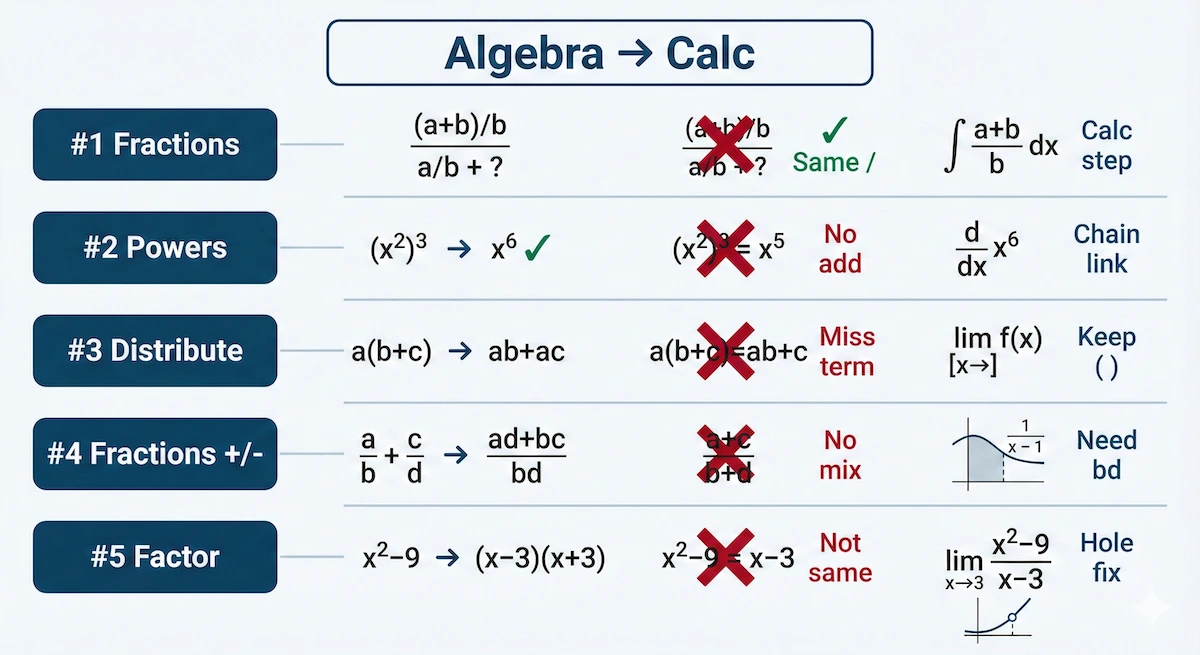
The five mistakes below are not random. They map to the five algebraic operations most frequently required in introductory calculus: cancellation, exponent manipulation, distribution, fraction operations, and factoring. Students preparing for AP exams can find targeted support through an AP Calculus tutor.
Students who consistently get the wrong sign on reactions, get 0/3 on limit problems they “understand,” or watch their partial credit disappear in the simplification steps are nearly always making one of these five errors.
Mistake #1: Incorrectly Canceling Terms (Canceling Addition/Subtraction)
The Error
The most frequent cancellation error in calculus work is treating addition and subtraction as if they were multiplication. The rule that allows cancellation — dividing numerator and denominator by a common factor — applies only to factors, never to terms. A factor is something multiplied. A term is something added or subtracted.
The incorrect pattern looks like this: Wrong: (x + 3) / (x + 5) simplified to 3/5 by “cancelling x.” The x here is a term in both the numerator and denominator, not a factor. It cannot be cancelled. The only valid simplification would require factoring both expressions first, and in this case no common factor exists. The expression is already in its simplest form.
Why It Happens
Students learn early that (3x) / (5x) = 3/5 because x divides both numerator and denominator as a factor. Under time pressure, the brain pattern-matches to “x appears top and bottom” without checking whether x is a factor or a term. This automatic pattern recognition fails whenever addition or subtraction separates the x from other parts of the expression.
How to Fix It: The Factor-First Rule
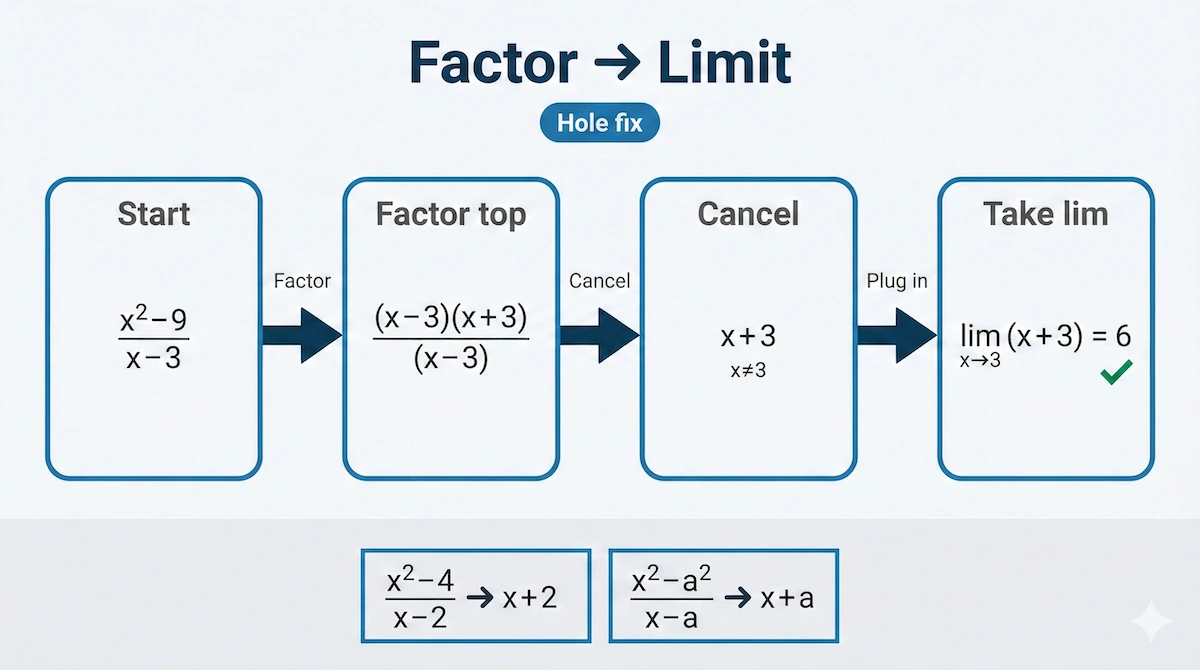
Before cancelling anything, factor completely — then cancel only factors that appear in both numerator and denominator. If you cannot factor an expression into a product, you cannot cancel anything inside it.
Apply this three-step check before every cancellation:
- Can I write both numerator and denominator as products (not sums)?
- Does the same factor appear in both?
- Am I dividing by that factor, not subtracting it?
If any answer is no, cancellation does not apply. The habit takes roughly 90 seconds per problem to build initially and becomes automatic within two weeks of consistent practice.
Impact on Calculus
This error appears most destructively in limit evaluation. The standard method for resolving a 0/0 indeterminate form is to factor the numerator and denominator, then cancel the common factor that produced the zero.
A student who cancels terms instead of factors will either cancel nothing (leaving the indeterminate form unsolved) or cancel incorrectly (producing a wrong numerical answer). Both outcomes result in zero marks for a problem the student understood at the calculus level.
Example: lim(x→2) of (x² – 4) / (x – 2). Correct approach: factor numerator as (x+2)(x–2), cancel (x–2), evaluate at x=2 to get 4. A student who cancels x² from x² – 4 and x from x – 2 separately gets a different expression entirely, misses the cancellation, and fails to resolve the limit. This is a zero-mark outcome from a pure algebra error.
Mistake #2: Misunderstanding and Misapplying Exponent Rules
The Error
Exponent errors cluster into two categories. The first is adding exponents when multiplying bases that are not identical: x² × y³ does not equal (xy)^5. The second, more damaging in calculus, is applying the power rule to sums: (x + y)^n does not equal x^n + y^n for any n other than 1. Both errors share the same root cause — treating exponent rules as applying more broadly than they do.
A particularly persistent variant is (a + b)² = a² + b². Students who write this instead of a² + 2ab + b² are applying the power rule to a sum, which is never valid. This specific error invalidates the expansion step required in dozens of calculus procedures including the definition-of-derivative limit and completing the square for integration.
Why It Happens
The rule x^a × x^b = x^(a+b) is learned correctly but then over-generalised. Students remember “multiply → add exponents” and apply it whenever they see multiplication — even when the bases differ. The sum-power error is reinforced by distributive property intuition: if multiplication distributes over addition, students assume powers do too.
Understanding how these errors compound across topics is one reason many students seek help with calculus homework before exam periods. For a broader look at how algebra underpins competitive exam performance, see how online math tutoring prepares students for competitive exams.
How to Fix It: The Seven Essential Exponent Laws
Mastering seven exponent laws eliminates the overwhelming majority of exponent errors in calculus. These seven rules, as compiled in standard pre-calculus references including the MIT OpenCourseWare algebra review, govern every exponent operation encountered in introductory calculus:
| Rule | Form | Common Calculus Context |
|---|---|---|
| Product rule | x^a × x^b = x^(a+b) | Simplifying before differentiating |
| Quotient rule | x^a / x^b = x^(a–b) | Rational function simplification |
| Power of a power | (x^a)^b = x^(ab) | Chain rule applications |
| Zero exponent | x^0 = 1 (x ≠ 0) | Limit simplification |
| Negative exponent | x^(–n) = 1/x^n | Converting before integration |
| Fractional exponent | x^(1/n) = nth root of x | Differentiation of radical functions |
| Product to power | (xy)^n = x^n × y^n | Simplifying composite expressions |
The critical non-rule to memorise is: (x + y)^n ≠ x^n + y^n. Write this on an index card, keep it visible during practice sessions, and check every exponent operation involving a sum or difference against it. Per the MIT 18.01SC Single Variable Calculus course materials, algebraic manipulation fluency — including correct exponent application — is treated as a pre-session prerequisite, not a topic covered in class.
Impact on Calculus
Exponent errors eliminate correct answers from three of the most tested calculus procedures: the power rule for differentiation (which requires correctly identifying the exponent before subtracting 1), the definition of the derivative (which requires expanding (x+h)^n correctly before letting h approach zero), and integration by the reverse power rule (which requires adding 1 to the correct exponent).
A student who misapplies (x+h)² = x² + h² when computing a derivative from first principles will never reach the correct derivative, regardless of their understanding of the limit concept.
Mistake #3: Not Distributing Properly (FOIL and Distributive Property)
The Error
Distribution errors take two forms. The first is partial distribution: a(b + c) = ab + c instead of ab + ac. The second is sign errors during distribution of a negative: –(x + 3) = –x + 3 instead of –x – 3. Both forms are individually straightforward to fix but persistently recur under time pressure because students rush the expansion step and fail to apply the operation to every term.
The FOIL-specific error is forgetting the middle terms when squaring a binomial: (x + 3)² written as x² + 9 instead of x² + 6x + 9. The two missing middle terms (the OI terms in FOIL) represent exactly the cross-product that the (x + y)^n ≠ x^n + y^n rule warns against, which is why this error clusters with exponent mistakes in exam papers.
Why It Happens
Distribution requires tracking every pairing between terms. Under exam pressure, working memory narrows, and students complete the “obvious” pairings (first × first, last × last) while skipping the cross terms. Negative distribution compounds this because the sign change must be applied to every term in the bracket, and a single missed application flips the entire subsequent result.
How to Fix It: The Systematic Method
Replace intuitive expansion with a mechanical, step-by-step process that does not rely on working memory to “remember” terms. Two methods work reliably under exam pressure.
For binomial multiplication: Draw arrows from each term in the first bracket to each term in the second. Count the arrows: two terms × two terms = four arrows = four partial products. Write all four before simplifying anything.
For negative distribution: Before distributing, rewrite –(expression) as (–1)(expression). Then distribute –1 explicitly to every term. This single rewrite step eliminates nearly all sign errors in negative distribution.
Impact on Calculus
Distribution errors most frequently appear in differentiation using the product rule and quotient rule, where the numerator or denominator of a result must be expanded before simplification.
They also appear at a critical step in the definition-of-derivative limit: expanding (x + h)^n. In that context, missing the cross terms means the h terms that are supposed to cancel or be divided out never appear, the entire limit collapses to an incorrect form, and the student gets 0 marks on a derivative computation they would have executed correctly had the expansion been right.
Students working through AP Calculus AB or BC courses encounter these distribution demands repeatedly. Targeted support from an AP Calculus AB tutor can help identify which expansion habits need correction before they cost marks on the exam.
Mistake #4: Fraction Manipulation Errors (LCD and Cancellation)
The Error
Fraction errors in calculus fall into three predictable patterns. Adding numerators across different denominators directly: a/b + c/d = (a+c)/(b+d). Cancelling individual terms in a numerator or denominator rather than factors: (x² + 3x) / (x² + 5) simplified by “cancelling x².” And finding an incorrect LCD by multiplying denominators that share a common factor, which produces an unnecessarily complex expression that is harder to simplify and more likely to generate errors in subsequent steps.
Why It Happens
Students who work primarily with simple numerical fractions in arithmetic develop the habit of treating the numerator and denominator as independent quantities. The rule for addition of equal-denominator fractions — add the numerators — is then misapplied to unequal denominators by skipping the LCD step. Cancellation errors, as with Mistake #1, stem from pattern-matching “same thing appears top and bottom” without checking whether the common element is a factor or a term.
How to Fix It: Systematic Fraction Rules
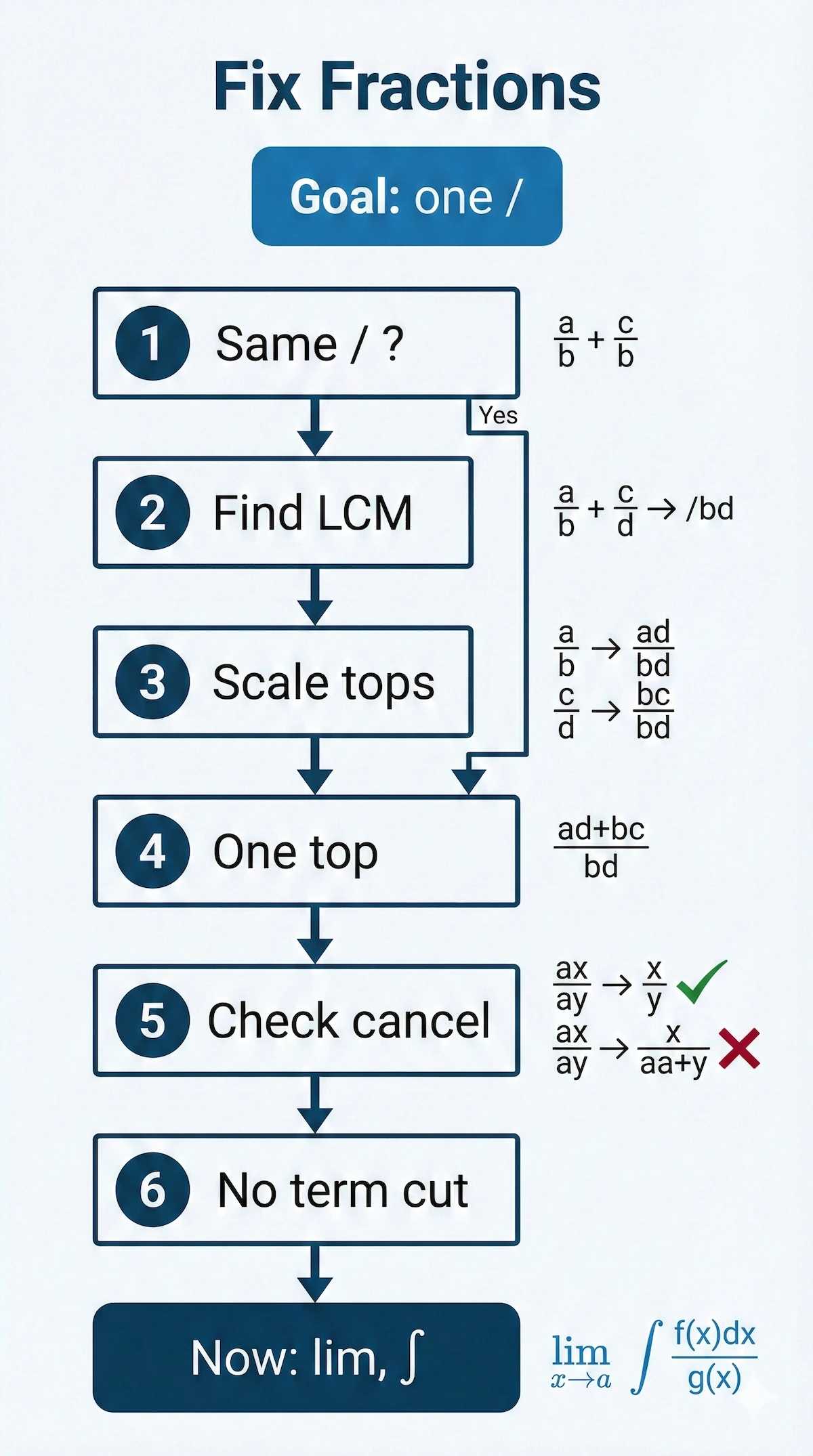
For adding or subtracting fractions with different denominators, apply this sequence without skipping steps:
- Factor each denominator completely.
- Identify the LCD as the product of each distinct factor at its highest power.
- Rewrite each fraction with the LCD as denominator by multiplying numerator and denominator by whatever factor is missing.
- Add or subtract numerators only (denominators stay as LCD).
- Factor the resulting numerator and cancel with any factors in the denominator.
For cancellation, apply the Factor-First Rule from Mistake #1: cancel only after the numerator and denominator are fully factored as products.
Impact on Calculus
Fraction errors are particularly costly in three calculus areas. First, limit evaluation involving rational expressions requires combining fractions over a common denominator before applying L’Hopital’s rule or factoring. Second, computing derivatives of rational functions via the quotient rule generates compound fractions that must be simplified correctly to produce a usable result.
Third, partial fraction decomposition in integration requires setting up fraction equations with correct denominators and solving for numerator coefficients — an error in the LCD step at the start propagates through every subsequent step in the decomposition.
Per the treatment in Stewart’s Calculus: Early Transcendentals (Appendix A), algebraic fraction manipulation is classified as a prerequisite skill listed for review before Chapter 1, reinforcing that fraction errors represent a pre-calculus gap, not a calculus gap.
Mistake #5: Factoring Mistakes (Missing GCF, Incomplete Factoring)
The Error
Factoring errors in calculus are rarely about getting factoring entirely wrong. The most damaging pattern is incomplete factoring — stopping one step short. A student factors x³ – x as x(x² – 1) and stops, missing that (x² – 1) factors further into (x+1)(x–1) as a difference of squares. The result is a partially factored expression that still cannot be simplified, and the student concludes the problem is unsolvable by factoring.
The second pattern is missing the Greatest Common Factor (GCF) at the start. Attempting to factor 4x³ – 8x² + 4x without first extracting 4x produces a much harder trinomial than necessary. Students who skip the GCF step spend time on complex factoring attempts that would have been trivially simple after pulling out the common factor.
Why It Happens
Incomplete factoring occurs because students test whether they “can” factor an expression rather than whether it is “fully” factored. Without a systematic final check, stopping at x(x² – 1) feels complete — the expression has been transformed from a cubic to a product. The GCF miss usually results from not scanning all terms for common factors before attempting quadratic or higher-degree methods.
For a deeper look at how algebra structures like these connect to higher-level coursework, this guide to why linear algebra is a superpower explains the broader pattern.
7 Warning Signs You Need an Algebra Tutor Before Calculus (2026)
How to Fix It: The Factoring Ladder
Apply the Factoring Ladder in sequence on every expression — do not skip steps and do not stop until every factor is irreducible:
- GCF first: Extract the largest factor common to all terms. Do this before anything else.
- Count terms: 2 terms → check difference of squares or sum/difference of cubes. 3 terms → use AC method or trial factoring. 4 terms → try grouping.
- Check each factor: After factoring, check each resulting factor. Can it be factored further? Keep going until every factor is prime or irreducible.
- Verify by expanding: Multiply the factors back out. If you recover the original expression, the factoring is correct and complete.
The “check each factor” step is what most students skip. Making it a mandatory checklist item — literally checking a box before moving on — reduces incomplete factoring errors by forcing the completeness check that intuition tends to skip.
Impact on Calculus
Incomplete factoring directly blocks limit resolution. The standard technique for evaluating limits of the form 0/0 at a point is: factor both numerator and denominator, cancel the common factor that caused both to equal zero at that point, then substitute. If factoring is incomplete, the common factor remains hidden inside a partially factored expression that looks irreducible.
The student correctly applies the calculus technique (factoring to resolve indeterminate form) but fails to execute the algebra fully, producing an unsimplifiable expression that they then incorrectly label as “does not exist.”
Factoring also controls the entire chain of U-substitution in integration: recognising the form, factoring the integrand into function and derivative components, substituting, and integrating. An incomplete factoring step at the recognition stage means the substitution is never identified, and the integral appears unsolvable by a method that would have worked.
Quick Diagnostic: Which Mistake Is Costing You the Most?
Before starting the study plan below, run this five-minute self-audit. For each statement, answer yes or no based on your last three calculus assignments or exams.
| # | Diagnostic Statement | Likely Mistake |
|---|---|---|
| 1 | I lose marks on limits that reach 0/0 — I set up the method right but the simplification fails. | Mistake #1 (Cancellation) or #5 (Factoring) |
| 2 | My derivative from first principles is always wrong even though I know the limit definition. | Mistake #2 (Exponents) or #3 (Distribution) |
| 3 | I get wrong signs after expanding brackets, especially with negative signs outside. | Mistake #3 (Distribution) |
| 4 | My quotient rule or rational function derivatives come out messy and I can’t simplify them. | Mistake #4 (Fractions) or #1 (Cancellation) |
| 5 | I correctly identify that I need to factor but end up with an expression that won’t simplify. | Mistake #5 (Incomplete Factoring) |
Any “yes” answer points directly to the mistake causing the most damage. Prioritise that mistake in the study plan below rather than working through all five in order.
Common Mistakes Across All Five: Lack of Verification
Every one of the five mistakes described above is immediately detectable by a single verification habit: substituting a numerical value into both the original expression and the simplified result to check that they match.
This check takes under 20 seconds and catches 100% of incorrect simplifications. If (x² – 4)/(x – 2) simplifies to (x + 2), substitute x = 3 in both: original gives (9 – 4)/(3 – 2) = 5/1 = 5. Simplified gives 3 + 2 = 5. They match — the simplification is correct. If they do not match, the simplification contains an error. This test is simple enough to apply to every algebraic simplification step in exam conditions and catches the specific errors described in Mistakes #1 through #5 before they propagate.
Students who get the wrong sign on reactions, who consistently lose marks in the “simplification” row of partial credit, or who find that the last few lines of their calculus solutions go wrong every time are exactly the students for whom a 20-second verification check per simplification step would recover the most marks.
Actionable Study Plan to Fix These Mistakes
The four-week plan below is sequenced to build the fixes for each mistake before that mistake appears in your upcoming calculus coursework. Adjust the timing to align with your course calendar — if integration is your next major topic, move the fraction work from Week 3 earlier.
Week 1–2: Diagnostic and Assessment
Retrieve your last two graded calculus assignments. For every question where you lost marks, identify which step the error occurred in. Classify each error as one of the five mistake types above. Count which type appears most frequently — that is your priority target.
Gather three additional problems of each type from Khan Academy or your course textbook appendix. Attempt all three cold, without reviewing the fix. Mark which steps fail. This baseline tells you where your automatic behaviour is and measures your starting point before correction.
Week 2–3: Focused Remediation
Work through each fix in the order they appear in your diagnostic results, highest-frequency mistake first. For each mistake type, complete ten practice problems applying only the fix method for that mistake: the Factor-First Rule for cancellation, the seven exponent laws for exponent errors, the systematic expansion method for distribution, the LCD sequence for fractions, and the Factoring Ladder for incomplete factoring.
After every ten problems, run the numerical verification check on each simplification. If you find a mismatch, trace back to identify which mistake type caused it. Add that type to a running tally to track whether frequency is shifting. The goal at the end of Week 3 is zero errors across ten consecutive problems for each mistake type, verified numerically.
Week 3–4: Integration with Calculus
Return to full calculus problems — limits, derivatives, integrals — that require the algebraic skills you have practised. Work each problem fully, but flag every algebra step. After completing the calculus procedure correctly, verify each flagged algebra step numerically.
The purpose is not just to get the final answer right but to confirm that each individual algebra step is independently verifiable. This step mirrors what happens on an exam when a marker awards partial credit: correct setup and incorrect simplification still loses marks. Your goal is to make the algebra steps independently correct, not incidentally correct because they happened to combine into the right answer.
Ongoing: Prevention
After Week 4, maintain the verification habit permanently. Keep the seven exponent laws and the Factor-First Rule visible during any algebra-heavy study session.
If you are working with a AP Calculus BC tutor, ask them to flag any algebra error immediately during session — do not wait for a graded paper to discover a persistent algebra pattern. The fastest way to close algebra gaps that are costing you calculus marks is real-time feedback during worked examples, not post-hoc error analysis on returned homework.
For students comparing tutoring options, see the review of the best online tutoring services and the guide to statistical software tutoring for context on how different formats compare.
Algebra Mistake Comparison: What Goes Wrong vs. What to Do
The table below summarises all five mistakes, their most common calculus context, and the exact corrective action for each. Use it as a quick-reference card during revision sessions.
| Mistake | Classic Wrong Move | Top Calculus Context | Fix in One Line |
|---|---|---|---|
| #1 Cancellation | Cancelling terms (x) not factors | Resolving 0/0 limits | Factor first; cancel only factors |
| #2 Exponents | (a+b)² = a² + b² | Derivative from definition | Memorise the seven exponent laws; expand sums with FOIL |
| #3 Distribution | Missing cross terms or sign flip | Product/quotient rule expansion | Write all four FOIL terms; rewrite –( ) as (–1)( ) first |
| #4 Fractions | Adding numerators across different denominators | Partial fractions; rational derivatives | Find LCD; rewrite each fraction; then add numerators |
| #5 Factoring | Stopping before expression is fully factored | Limit resolution; U-substitution | Use Factoring Ladder; check each factor; verify by expanding |
Do You Need Extra Support for These Algebra Gaps?
Most students can close the five algebra gaps above independently using the fix methods and study plan in this article. A tutor becomes the faster route when the same error keeps returning despite deliberate practice — usually because a procedural misconception formed earlier in education needs to be directly corrected through worked examples with real-time feedback, not just repeated practice of the wrong habit.
If you recognise yourself as the student who “understands” each fix when reading it but then reverts to the error on timed problems, that is a signal that the gap is procedural, not conceptual, and one-to-one problem-based work is likely more efficient than further self-study.
MyEngineeringBuddy offers private 1:1 online tutoring sessions via Google Meet, available on-demand — connect via WhatsApp at +91 8971 383660 or email [email protected] and get matched with a tutor who will work through your specific error patterns in a live session.
For students who prefer to assess the service before committing, see the online tutoring cost guide for a breakdown of what to expect from different tutoring formats and how MEB’s per-session model compares to subscription alternatives.
Frequently Asked Questions About Algebra Mistakes in Calculus
Why do algebra mistakes affect calculus grades so severely?
Calculus problems are graded step-by-step. Partial credit is awarded for correct setup and correct calculus procedure. When the algebra simplification step is wrong, the final answer is wrong — and because most marking schemes require a correct final answer to award full marks, even a single algebra error in a multi-step problem can cost the majority of available marks. The calculus reasoning earns partial credit; the algebra error eliminates the marks for the correct answer.
How long does it take to fix these algebra mistakes in calculus work?
Students who identify their one or two highest-frequency algebra mistakes and apply focused daily practice for two to three weeks typically report zero recurrence of those specific errors on subsequent exams. The fixes described here are procedural, not conceptual — they require building a new step-by-step habit, not learning new theory. Procedural habits take roughly 100 repetitions to become automatic. At ten problems per day, that is ten days per mistake type.
Can I fix these algebra mistakes on my own or do I need a tutor?
Most students can fix these algebra mistakes independently using the methods in this article, provided they apply numerical verification to catch errors during practice. A tutor accelerates the process specifically when the same error recurs despite deliberate practice — a signal that the procedural misconception is deeper than a simple habit change can address. In that case, live worked examples with real-time correction are faster than self-study.
Which of the five algebra mistakes causes the most calculus exam failures?
Incorrect cancellation (Mistake #1) and incomplete factoring (Mistake #5) together account for the largest share of mark losses on limit problems, which are typically worth a significant proportion of first-semester calculus exams. Students who consistently get the wrong answer on indeterminate-form limits despite using the correct method are almost universally making one of these two algebra errors.
Should I review algebra before starting a calculus course?
Yes, and specifically target the five areas in this article: cancellation rules, exponent laws, distribution and expansion, fraction operations, and factoring techniques. Most universities list algebraic manipulation fluency as a formal prerequisite for calculus. Spending one to two weeks on targeted algebra review before a calculus course significantly reduces the probability of the exam failures described here. The MIT OpenCourseWare Single Variable Calculus materials include a pre-session algebra review that covers exactly these five areas.
Verified Sources and Resources
- College Board AP Calculus AB/BC Course and Exam Description — prerequisite algebra competencies listed in the course framework (collegeboard.org)
- MIT OpenCourseWare 18.01SC: Single Variable Calculus — pre-session algebra review materials covering exponent laws and algebraic manipulation
- Stewart, J. Calculus: Early Transcendentals, Appendix A: “Algebra Review” — covers algebraic fractions, factoring, and exponent laws as declared prerequisites
- Journal of Research in Mathematics Education, Vol. 49 (2018) — prior knowledge and algebra skill as predictors of calculus performance
Related Reading
******************************
This article provides general educational guidance only. It is NOT official exam policy, professional academic advice, or guaranteed results. Always verify information with your school, official exam boards (College Board, Cambridge, IB), or qualified professionals before making decisions. Read Full Policies & Disclaimer , Contact Us To Report An Error