
Physics Tutor Cost Guide: What You’ll Pay, Regional Rates & Hidden Fees (2026)

Finding a physics tutor is the easy part. Figuring out what you’ll actually pay is where things get complicated. Physics tutoring costs vary wildly from free YouTube channels to $160 per hour for specialized AP exam coaches. Between hidden cancellation fees, travel surcharges, package minimums, and regional price differences, students and families often end up paying far more than the advertised rate.
It helps to think of tutor pricing like an iceberg. The hourly rate is just what you see above the surface.
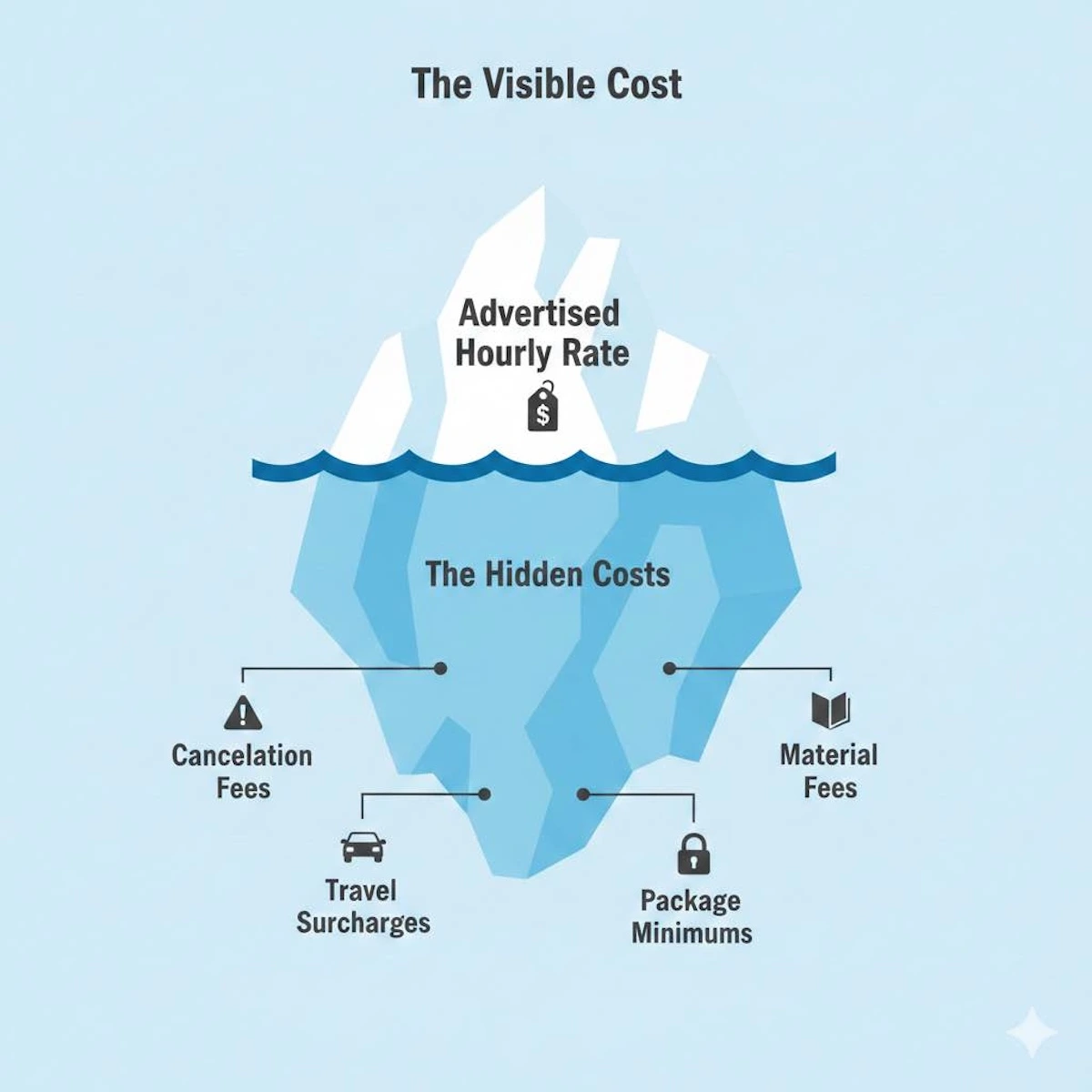
Like an iceberg, the advertised hourly rate is only what you see—hidden fees for travel and materials often lie beneath the surface.
Keep this visual in mind when negotiating; asking about ‘below the water’ fees upfront can save you hundreds of dollars.
This guide breaks down exactly what physics tutoring costs in 2026, where prices differ by region, and which hidden fees catch most people off guard. Whether you’re comparing online platforms or negotiating with a local tutor, you’ll know the real price before you commit.
Hire Verified & Experienced Online Tutoring
The Student Pulse: What Are People Actually Asking?
Reddit forums and student communities reveal consistent frustration: “Physics tutoring costs way too much” and “I need help but can’t afford it.” The pattern is clear. Students want quality physics instruction but face real budget constraints. More importantly, they struggle to understand why rates vary so dramatically and whether paying more actually gets better results.
The recurring questions suggest three core concerns: Can I find tutoring I can afford? What exactly am I paying for? and Will this tutor be worth the cost? These questions deserve clear answers, not marketing speak.
To give you a realistic baseline, here is a snapshot of current hourly rates across major regions and platforms for 2026.
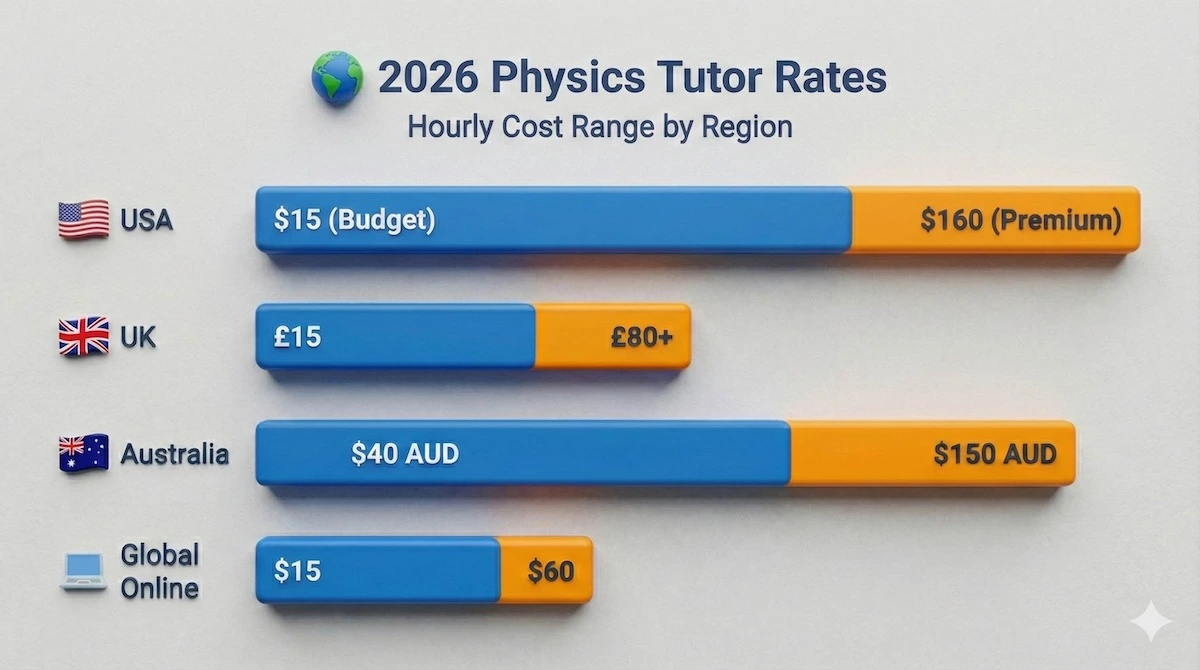
Rates vary significantly by region; this chart shows the spread from budget online options to premium in-person coaching in 2026.
As you can see, geography plays a massive role—but online platforms tend to normalize these costs significantly.
Global Physics Tutoring Rates at a Glance
United States
Online Tutoring:
- Budget tier: $15-25/hour (platforms like Wiingy)
- Mid-range: $35-60/hour (Wyzant, Preply, Tutor.com)
- Premium: $75-160/hour (specialized AP Physics coaches)
- Average across all platforms: $22.72/hour
In-Person Tutoring:
- General range: $60-100+/hour
- Premium markets (NYC, Boston, LA): $100-160+/hour
- Includes 15-30 minute travel buffer built into hourly rate
Top Platforms Compared:
| Platform | Entry Price | Typical Range | Best For |
| Wiingy | $15/hour | $15-40/hour | Budget-conscious students |
| Preply | $18/50-min | $18-50/hour | Verified 200+ physics tutors |
| Wyzant | $35/hour | $35-60/hour | Wide tutor selection |
| Tutor.com | $45/hour | $45+ | 24/7 on-demand help |
| Princeton Review | $39.99/month | $40-103/month | Bundled hours |
| TutorOcean | $5/hour | $5-182/hour | Extreme range, self-set rates |
United Kingdom
Online Tutoring:
- Budget: £15-25/hour
- Standard: £25-45/hour
- Premium: £50-80+/hour
In-Person Tutoring:
- Regional average: £40-80+/hour
- London premium: Often 20-30% higher due to travel time and cost of living
India
Group Classes:
- Classes 6-8: ₹800-1,000/month
- Classes 9-10: ₹1,000-1,500/month
- Classes 11-12: ₹1,500-2,000/month (board exam prep)
One-on-One Home Tuition:
- Classes 6-10: ₹2,000-4,000/month
- Classes 11-12: ₹4,000-6,000/month (up to ₹10,000+ for JEE/NEET specialists)
Online Platforms:
- Physics Wallah: ₹4,000-5,000/full course
- StudyNation: ₹500-1,500 per class
- Local tutors: ₹300-1,000 per session
Australia
Qualified Tutors:kisacademics
- University student tutors: AUD $40-65/hour
- Experienced tutors (ATAR 97+): AUD $60-90/hour
- Qualified teachers: AUD $80-150/hour
- IB/Selective school specialists: AUD $90-150+/hour
Global Physics Tutor Pricing Comparison (2026): Online vs In-Person Rates by Region
Struggling with Physics? Get online tutoring and homework help from the best Online Physics Tutor
Why Physics Tutoring Costs So Much More Than You’d Expect
1. Tutor Qualification Premium
The tutor’s background directly impacts price. A high school physics student tutoring might charge $15-25/hour. A physics graduate with teaching experience commands $40-60/hour. A master’s degree or Ph.D. typically adds $20-40 to the hourly rate. Physics teachers (those with credentials and classroom experience) often charge $80-150+/hour because they bring both subject depth and pedagogical skill.
The investment in expertise is real. A tutor with a Ph.D. in Physics spent 7-10 years developing specialized knowledge. That expertise doesn’t come cheap.
2. Specialization Markup
AP Physics, IB Physics, JEE Advanced, and NEET Physics are exam-specific tracks that demand tutors familiar with specific syllabi, question patterns, and time management strategies. These specialists charge $75-160/hour because demand is high and supply is limited. You’re paying for someone who knows exactly what the exam board will test.
Thermodynamics or quantum mechanics tutors also command premiums. Fewer tutors specialize in advanced topics, and students needing that help have limited alternatives.
3. Session Duration Economics
A 30-minute session typically costs $15. A 60-minute session costs $30. Longer sessions aren’t proportionally cheaper because tutors lose efficiency students need breaks, transitions, and processing time. Most tutors structure sessions as 45-60 minutes for optimal learning without premiums on longer blocks.
4. Online vs. In-Person Cost Gap
Online tutoring costs $20-60/hour. In-person tutoring costs $60-100+/hour. The difference? Travel time, fuel, vehicle wear, and the fact that one in-person session locks up 2-3 hours of a tutor’s day when you factor in commute.
A tutor charging $50/hour for online sessions might charge $75-85 for in-person from the same location just to account for lost productivity from travel.
5. Regional Price Variation (Even Within Countries)
Physics tutoring costs more in major metropolitan areas. In New York City, average rates are $100-160+/hour. In smaller Midwest cities, $35-50/hour is standard. The variation comes from:
- Cost of living (higher in metros)
- Tutor density (more competition in some areas, none in others)
- Student purchasing power (wealthy areas support higher rates)
- Travel distances (rural areas require expensive commutes)
London tutors charge 30% more than tutors in smaller UK cities. Sydney tutors command higher rates than regional Australian towns. This pattern repeats globally.
Mastering Physics with Online Tutors: A Guide for Students and Parents
Hidden Fees That Increase Your Total Cost
The advertised hourly rate is rarely the total cost. Hidden fees can add 20-40% to your bill.
Hidden Fees Breakdown: How Advertised Physics Tutor Rates Understate True Costs
Cancellation Penalties
Most tutors charge for cancellations made less than 24 hours in advance. Common policies:
- $5-15 for same-day cancellation (sometimes a full session fee)
- No refund for no-shows
- Some tutors require 48-hour notice
The logic tutors use: You cancelled at short notice, I can’t fill that slot with another student, so I lose income. Fair from their perspective. Expensive from yours if you cancel frequently.
Reddit tutoring communities confirm this is standard practice, with many tutors arguing that cancellation fees should equal a full hour’s rate (since that’s the income lost).
Package Minimums
Many tutors require 4-12 hour package commitments. Instead of paying per session, you pre-purchase a block of hours. This ensures predictable income for the tutor but locks you into commitment.
Package deals sometimes offer 10-15% discounts, but the total upfront cost can be $200-500+, which is a significant barrier for students considering part-time tutoring.
Materials and Test-Prep Fees
Some tutors charge extra for:
- Practice problem sets they create
- Mock exams
- Customized worksheets
- Test-prep guides
Not all tutors do this, but it’s increasingly common among premium tutors who market “comprehensive exam preparation.”
Travel Fees (In-Person Tutoring)
Tutors typically handle travel in one of two ways:
- Built into hourly rate: Charge $75-85 instead of $50, with the difference covering travel time
- Explicit surcharge: Charge $50/hour tutoring plus $10-15/hour travel time
Some tutors set a radius (for example, “I’ll travel up to 20 minutes for $X premium”). Others charge mileage based on the US government standard (currently around $0.67/mile). One tutor on Reddit noted he charges his full tutoring rate for travel time since it prevents him from seeing other students during that time.
Registration, Setup, or Onboarding Fees
Some platforms and tutoring centers charge:
- Account setup fee: $10-25
- Background check fee: $5-15
- Materials/resources fee: $10-30
These are one-time but easy to miss when you’re evaluating cost.
Trial Lesson Pricing
Most tutors offer a discounted or free trial. Some charge full price. Some offer 50% off. Check before booking because a trial at full price isn’t really a trial it’s a commitment.
Condensed Matter Physics Tutoring Online: A Complete Guide for Students and Parents
Free and Low-Cost Alternatives to Paid Tutoring
Before paying for a tutor, know what’s available for free:
Completely Free:
- Khan Academy Physics: Full unit library with 19 units from motion to AP physics
- YouTube channels (Michael Van Biezen, Organic Chemistry Tutor, Professor Dave Explains): Problem-solving walkthroughs
- University physics forums and Stack Exchange: Community answers to specific questions
- Your school’s tutoring center: Many high schools and universities offer free group tutoring through teaching assistants
Low-Cost or Freemium:
- LearnToBe: Free 1-on-1 online tutoring for low-income students (non-profit)
- Wyzant trial lesson: Often 50% off
- Preply trial: Discounted intro session
- Study groups: Form peer tutoring groups with classmates (free)
Why Some Students Still Pay:
Free resources require self-discipline, advanced learning skills, and the ability to identify what you don’t understand. A tutor accelerates this by diagnosing gaps you might not see yourself. For students struggling significantly or preparing for high-stakes exams, the ROI of paid tutoring often justifies the cost.
15 Game-Changing Physics Homework Hacks
Factors That Actually Affect Tutor Quality (Beyond Price)
Paying more doesn’t automatically mean better instruction. Consider these quality markers
Subject Expertise: Does the tutor explain the reasoning behind formulas, not just the formulas? Can they connect concepts across topics?
Communication Skills: Can they simplify complex ideas without oversimplifying? Do they ask clarifying questions to find where you’re stuck?
Teaching Philosophy: Do they focus on problem-solving frameworks (the how) or just answers (the what)? This connects to how tutors help students improve their academic confidence beyond just grade improvement.
Availability and Reliability: Do they start on time, respond to messages promptly, and follow through on commitments?
Progress Tracking: Can they track your improvement and adjust their teaching based on your specific weaknesses?
Trial Lesson Performance: The first session reveals more than rates. Does the tutor identify your learning style and adapt immediately?
Many $30/hour tutors outperform $100/hour tutors on these dimensions. Price is not a reliable quality indicator. Reviews, sample lessons, and direct communication matter more.
How to Negotiate Physics Tutoring Rates
If you’re budget-conscious or booking many hours, negotiation is possible.
Leverage Points:
- Bulk discounts: “I need 20 hours of tutoring. Can you offer a discount?” Most tutors offer 10-15% for packages.
- Regular schedule: “I’ll commit to Monday and Thursday 6pm sessions for 12 weeks.” Predictability justifies lower rates.
- Group sessions: “Can you tutor me and two classmates together?” Group rates are 30-50% lower per person.
- Off-peak timing: Sessions at 2pm on a Wednesday cost less than peak 6-8pm or weekend slots.
- Referral discounts: Some tutors credit $10-20 if you refer a friend.
- Direct hiring (non-platform): Hiring a local tutor directly (bypassing platforms like Wyzant) cuts out platform fees, sometimes reducing your cost by 10-20%.
What Won’t Work:
Don’t offer half the asking rate expecting agreement. Tutors receive these requests constantly and rarely accept. Instead, offer a value trade (longer commitment, group size, regular schedule) in exchange for modest discounts.
Comparing Online vs. In-Person: True Cost Breakdown
When deciding between virtual and physical lessons, you need to weigh more than just the hourly fee. Here is the full breakdown:
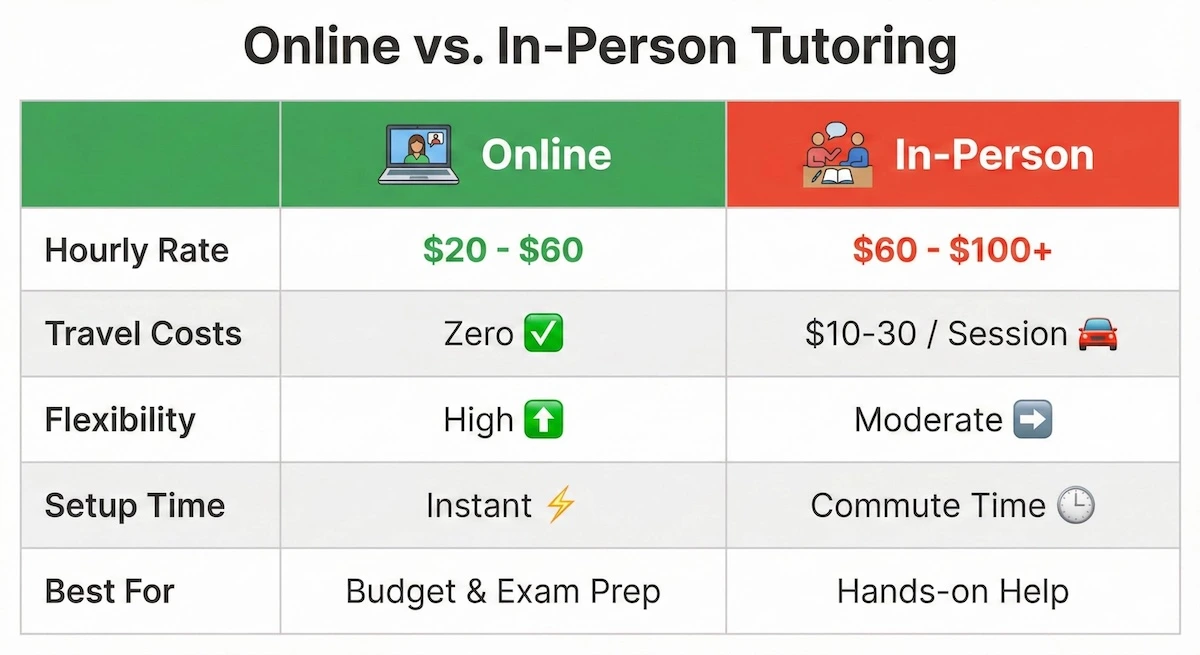
Online tutoring wins on price and flexibility, while in-person tutoring commands a premium for physical presence and travel time.
While online is the clear winner for budget and flexibility, in-person tutoring still holds value for students who need physical oversight.
| Factor | Online | In-Person | Winner |
| Hourly Rate | $20-60 | $60-100+ | Online |
| Travel Time Cost | $0 | $10-30/session | Online |
| Setup (internet/software) | $0-50 one-time | $0 | Roughly tied |
| Flexibility | Very high | Moderate | Online |
| Total for 10 sessions | $200-600 | $600-1,000+ | Online (40-50% cheaper) |
For exam prep or intensive tutoring, online tutoring saves hundreds of dollars while delivering comparable outcomes.
The cumulative difference over a standard 8-week prep course is staggering when visualized.
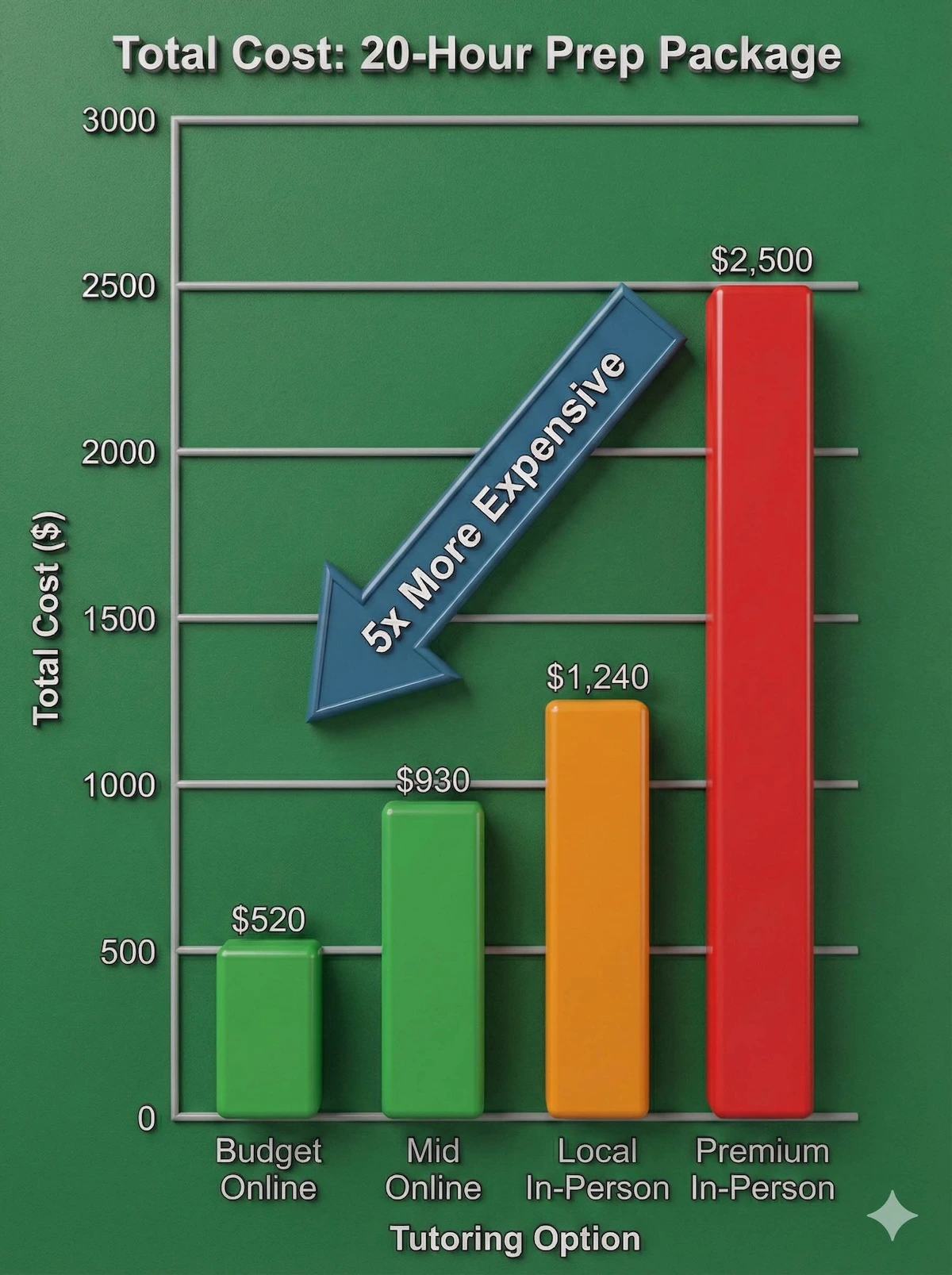
A 20-hour exam prep package can range from $520 to $2,500 depending on the format—online options offer massive savings for similar hours.
For the price of one premium in-person course, you could practically pay for five similar courses online.
Real-World Example: Total Cost of Exam Preparation
Let’s calculate actual costs for someone preparing for AP Physics:
Scenario: 20 hours of tutoring over 8 weeks
| Option | Hourly Rate | Hours | Base Cost | Hidden Fees | Travel | Total |
| Budget Online | $25 | 20 | $500 | $20 | $0 | $520 |
| Mid-Range Online | $45 | 20 | $900 | $30 | $0 | $930 |
| Premium Online | $80 | 20 | $1,600 | $50 | $0 | $1,650 |
| In-Person (Local) | $50 | 20 | $1,000 | $40 | $200 | $1,240 |
| In-Person (Premium) | $100 | 20 | $2,000 | $100 | $400 | $2,500 |
The variance is massive. Online tutoring can cost half as much as in-person for the same exam preparation.
Top 10 Benefits of Learning Physics Online
Regional Benchmark: What’s “Normal” to Pay?
US Students: $35-60/hour is standard for online, $60-100+ for in-person
UK Students: £25-45/hour online, £40-80+ in-person
India Students: ₹500-1,500 per session for 1-on-1, or ₹4,000-6,000/month for regular tutoring
Australian Students: AUD $60-100/hour for experienced tutors
If you’re quoted significantly higher or lower, investigate why. Higher prices should be justified by specialization, credentials, or proven results. Lower prices might indicate inexperience or lower qualification.
Red Flags: When Tutoring Costs Signal a Problem
Not sure if a tutor is trustworthy? Run their offer through this quick vetting checklist.
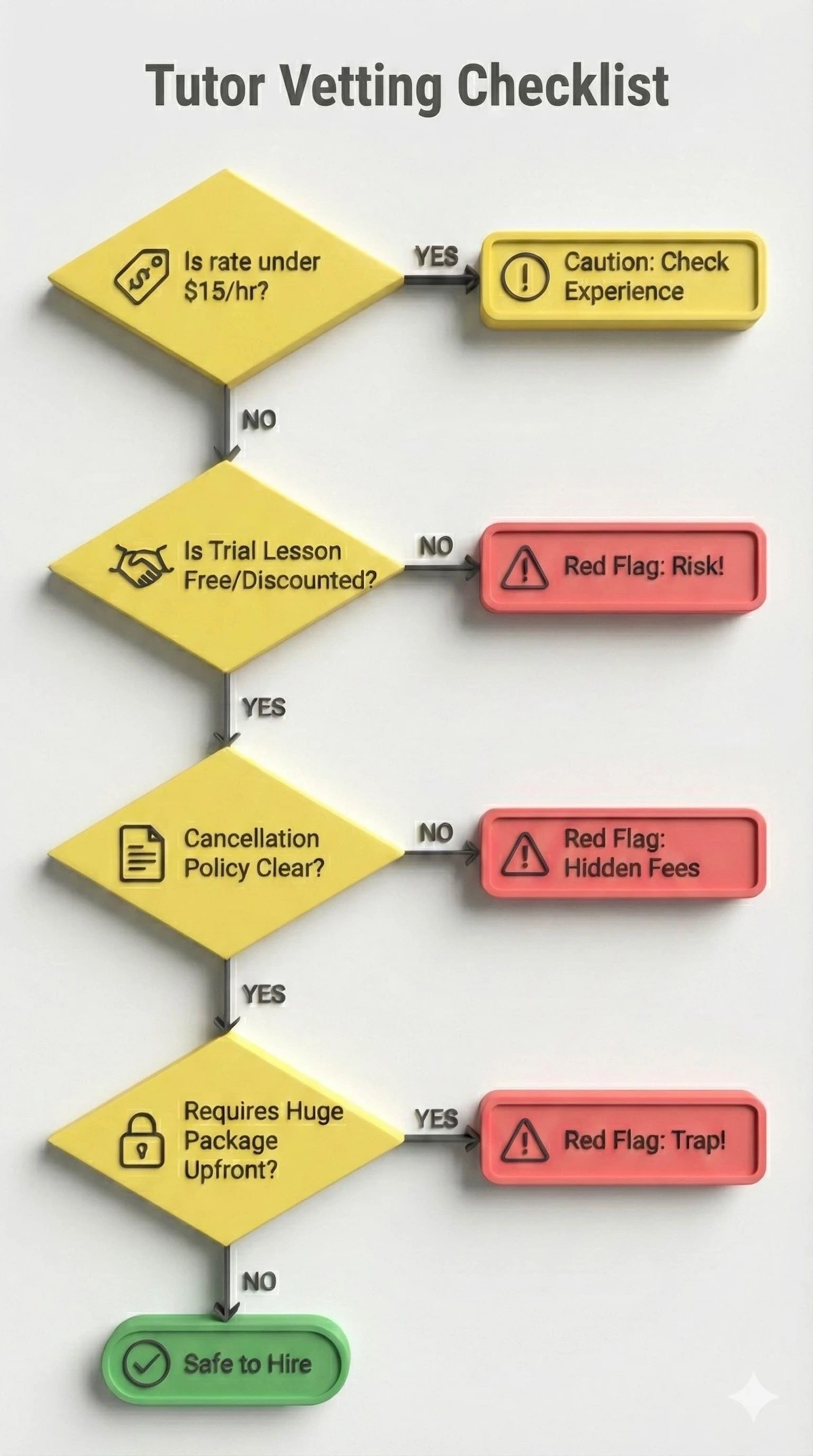
Follow this simple decision tree to identify red flags like unclear policies or forced packages before you commit your money.
If you hit a ‘Red Flag’ box, it doesn’t always mean you should run—but you should definitely ask clarifying questions before paying.
Too cheap (<$15/hour online): Usually indicates new tutors with minimal experience or non-native speakers with limited physics depth. Not always bad, but check reviews carefully.
No trial or money-back guarantee: Tutors confident in their ability offer low-risk trials. Refusal to offer one is a warning sign.
Unclear cancellation policy: Reputable tutors have written, clear policies. Vague responses suggest you’ll end up paying surprise fees.
Pressure to buy large packages upfront: Some tutoring centers push 12-20 hour packages before you’ve tried a lesson. This protects their revenue, not your interests.
Charges for cancelled sessions by the tutor: A tutor who cancels should reschedule at no cost. If they charge you when they cancel, move on.
Hidden material fees discovered mid-tutoring: Materials costs should be disclosed upfront, not added to invoices later.
Key Takeaways
- Online tutoring costs $20-60/hour; in-person costs $60-100+. The gap reflects travel time, not quality difference.
- Hidden fees add 20-40% to advertised rates. Budget for cancellation penalties, materials, travel, and package minimums.
- Regional variation is significant. NYC tutors charge 3x more than Midwest tutors. India offers the lowest rates globally.
- Specialization (AP, IB, JEE) commands $75-160/hour. You pay for narrow expertise and proven exam results.
- Free alternatives exist but require self-discipline. Khan Academy, YouTube, and university tutoring centers are worth exploring first.
- Price and quality are not tightly correlated. A $30/hour tutor can outperform a $100/hour tutor. Reviews and trial lessons matter more than rates.
- Bulk discounts and regular scheduling reduce cost by 10-20%. Negotiate for longer commitments, not lower hourly rates.
- In-person tutoring locks 2-3 hours of tutor time per session. This justifies the price premium but also limits availability.
Your Next Step
Start with a trial lesson. Most platforms offer discounted or free introductory sessions. You’ll quickly learn whether this tutor’s style fits your learning needs. Then calculate the total cost including hidden fees and commit to a timeline (4-12 weeks) rather than open-ended tutoring. This approach protects both your budget and your learning outcomes.
******************************
This article provides general educational guidance only. It is NOT official exam policy, professional academic advice, or guaranteed results. Always verify information with your school, official exam boards (College Board, Cambridge, IB), or qualified professionals before making decisions. Read Full Policies & Disclaimer , Contact Us To Report An Error